You’ve played fifteen rounds, you’ve lost more balls than you can count, and your scorecard has never shown a number below 105. Breaking 100 feels like it should be achievable — it’s not like you’re chasing a scratch handicap — but somehow those extra strokes keep creeping in. A duffed chip here, a three-putt there, a penalty shot from the trees on the 14th. The good news is that breaking 100 doesn’t require better swing mechanics or a £500 driver. It requires smarter decisions.
In This Article
- What Breaking 100 Actually Means
- The Mindset Shift
- Course Management: The Biggest Lever
- Tee Shots: Keep It in Play
- Approach Shots: Aim for the Middle
- Short Game: Where You Save Strokes
- Putting: Two Putts, Not Three
- Penalty Avoidance
- The Practice That Actually Helps
- A Realistic Round That Breaks 100
- Frequently Asked Questions
What Breaking 100 Actually Means
On a standard par-72 course, breaking 100 means scoring 99 or better. That’s 27 over par — which sounds like a lot until you realise it gives you an average of 5.5 strokes per hole. You can bogey every single hole and shoot 90. You can double-bogey half of them and bogey the rest and still shoot 99.
The Numbers Game
To break 100, you need to average no worse than a bogey-and-a-half per hole. That means:
- You can afford 9 double bogeys and 9 bogeys = 99
- You can afford 3 triple bogeys, 6 double bogeys, and 9 bogeys = 99
- You CANNOT afford more than a couple of holes where you take 7, 8, or 9
The enemy of breaking 100 isn’t the bad holes. It’s the disaster holes — the 8s and 9s that blow up your card. Eliminate those and you’re there.
Most UK Golfers’ Reality
The average UK male golfer has a handicap of about 16-18, which translates to roughly 88-90 per round. But roughly 40% of golfers who play regularly have never broken 100. If that’s you, you’re not alone, and the gap is smaller than you think. The R&A governs the world handicap system and tracks this data — your official handicap tells you exactly where you stand.
The Mindset Shift
The biggest change isn’t technical. It’s mental.
Stop Trying to Hit Great Shots
I know — that sounds backwards. But the golfer who tries to hit the 200-yard carry over water with a 3-wood is the golfer who writes down 8 on the scorecard. The golfer who lays up short of the water with a 7-iron and chips on is the one who writes down 6. Over 18 holes, those decisions add up to 10-15 strokes.
Play Your Actual Game
You hit your 7-iron 140 yards. Not 160, not 170 — 140. Use that number, not the one you managed once on the range with a tailwind. When the flag is 150 yards away, take the 6-iron. Ego is the most expensive club in your bag.
Accept Bogeys
A bogey is not a bad score when you’re trying to break 100. It’s a good score. If you bogey all 18 holes, you shoot 90. Stop chasing pars on every hole and start playing for bogey. When a par happens, enjoy it — but don’t chase it.
Course Management: The Biggest Lever
Course management is the boring-sounding skill that separates a 105 from a 95. It’s not about how well you hit the ball — it’s about where you aim it.
Play Away from Trouble
On every shot, identify where the trouble is (water, out of bounds, trees, bunkers) and aim away from it. This sounds obvious. It isn’t, because most golfers aim at the flag instead of the safe zone.
If the pin is tucked behind a bunker on the left, aim at the middle or right of the green. If there’s water down the right side of a fairway, aim at the left centre. You’re not giving up — you’re reducing the chance of a card-wrecking disaster hole.
The 150-Yard Approach
When you’re 200+ yards from the green, don’t try to reach it in one. Hit to your comfortable 150-yard mark, then hit your approach from there. Two controlled 150-yard shots beat one attempted 300-yard smash that ends in the rough, behind a tree, or in someone’s back garden.
Par 5 Strategy
Par 5s are where high-handicappers blow up. The temptation to go for the green in two is enormous and almost always wrong. Play them as three-shot holes:
- Tee shot — whatever keeps it in the fairway (even if that’s a 5-iron)
- Layup — to your favourite approach distance
- Approach — onto the green
- Two putts for bogey at worst
This approach turns par 5s from your worst holes into your most consistent.
Tee Shots: Keep It in Play
The tee shot sets up everything that follows. A straight 180-yard drive in the fairway is worth more than a 250-yard slice into the trees.
Club Selection
Here’s a radical idea: don’t hit driver on every hole. If your driver is inconsistent (and for most 100+ golfers, it is), consider hitting a hybrid, 5-iron, or even 7-iron off the tee on tighter holes. You’ll sacrifice distance but gain accuracy, and accuracy matters more below 100.
The Priority
Your only job off the tee is to put the ball in a position where your next shot is simple. That means:
- In the fairway or light rough — not behind trees, in a bunker, or out of bounds
- Within range of the green in regulation +1 — you don’t need to reach the green in two shots
- On the correct side — if trouble is right, miss left
When to Hit Driver
Hit driver when the fairway is wide, there’s no trouble on either side, and distance actually helps. On a wide par 5 with no hazards? Fire away. On a tight par 4 with OB left and trees right? Leave the driver in the bag. Our beginner’s guide to golf covers the basics of club selection if you’re still learning which club does what.
Approach Shots: Aim for the Middle
This is the simplest piece of advice that will save you the most strokes.
The Centre Green Rule
Always aim for the centre of the green. Not the flag — the centre. On most UK greens, the centre is no more than 10-15 metres from the pin. Hitting the centre of the green gives you a makeable putt for par and a near-certain two-putt for bogey. Aiming at a tucked pin gives you a bunker shot, a chip from the fringe, or worse. For a related angle, see our How to Book a Golf Holiday: Packages, DIY & Group Tips guide.
Distance Control Matters More Than Direction
At the 100-shooting level, most missed greens are short — not left, not right, but short. Take one more club than you think you need. If the gap says 145 yards and you’re between 7-iron and 6-iron, take the 6-iron every time.
The Front Edge Principle
The front edge of the green is always a better miss than the back. Short of the green gives you a chip with plenty of green to work with. Over the green often leaves you in trouble — downhill chips, thick rough, or a bunker with no green to play with.
Short Game: Where You Save Strokes
The short game is where 100+ golfers lose the most strokes and where improvement pays the biggest dividend.
The Bump-and-Run
For chips within 30 yards of the green, the bump-and-run is the highest-percentage shot. Take a 7-iron or 8-iron, play the ball back in your stance, and make a putting stroke. The ball pops forward, lands on the fringe, and rolls towards the hole like a putt.
This is less exciting than a lofted flop shot, but it’s also less likely to end up sculled across the green or chunked into the ground. At this level, boring and reliable beats flashy and risky every single time.
Basic Bunker Technique
If you dread bunkers, learn one simple technique:
- Open the clubface of your sand wedge before gripping
- Aim 5cm behind the ball
- Swing through the sand — don’t try to pick the ball clean
- Follow through — the most common mistake is decelerating
The goal isn’t to get close to the pin. It’s to get out of the bunker and onto the green in one attempt. Getting up and down from a bunker is a bonus. Leaving the ball in the bunker costs you 2-3 strokes. Our Best Golf Balls for Beginners 2026 guide is useful alongside this.
The Rule of 12
A simple chip-shot formula: subtract the loft of the club from 12 to estimate the roll ratio. A pitching wedge (roughly 46°) gives about a 1:1 air-to-roll ratio. An 8-iron gives roughly 1:3 — the ball flies a quarter of the total distance and rolls three-quarters. Use more lofted clubs when you need to stop the ball quickly, less lofted clubs when you have plenty of green to work with.
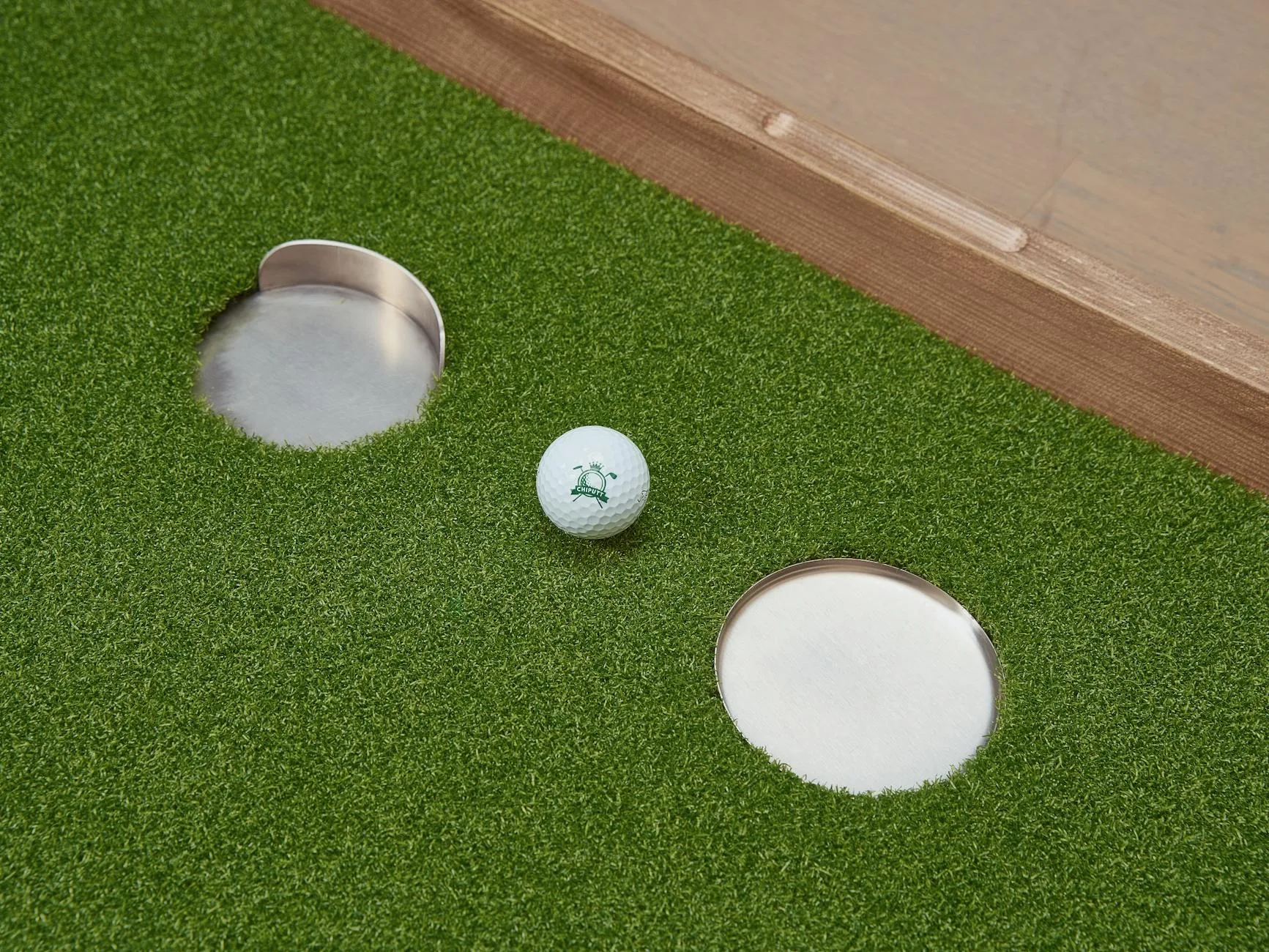
Putting: Two Putts, Not Three
Three-putts are score killers. Every three-putt costs you a stroke you didn’t need to give away.
Lag Putting
On putts over 6 metres, forget about holing it. Your goal is to get the ball within a 1-metre circle of the hole — close enough that the second putt is a tap-in. Pace control matters more than line on long putts. Hit the ball to the right distance and you’ll rarely three-putt.
The 1-Metre Circle Drill
On the practice green, put four tees in a circle 1 metre from the hole. From 8 metres, try to stop every putt inside the tees. Do this for ten minutes before a round and your lag putting improves immediately. This is the single most effective putting drill for high-handicappers.
Read Less, Commit More
At the 100-shooting level, you’re not misreading putts — you’re hitting them the wrong speed. Spend less time reading the break and more time feeling the distance. A putt that’s the right pace with slightly wrong line finishes close. A putt that’s the wrong pace with the perfect line finishes 3 metres past or 3 metres short.
Penalty Avoidance
Penalty strokes are the silent round-killers. Every time you hit into water, OB, or take an unplayable lie, you’re adding at least two strokes to your score (the penalty plus the recovery). We cover a similar decision in How to Putt: Reading Greens & Stroke Guide.
The Maths
If you take four penalty strokes in a round (fairly typical for a 100+ golfer), eliminating them drops your score by 4-8 strokes. That alone might be enough to break 100.
How to Avoid Them
- Know where OB is — check the scorecard or course guide before each hole
- Don’t hit over water unless you can carry it 80% of the time — lay up if there’s any doubt
- Take a provisional ball — if your tee shot might be lost, hit another one immediately. Walking back to the tee adds time and frustration. Our guide to golf etiquette covers the rules around provisionals.
- Accept the drop — if your ball is behind a tree with no shot, take an unplayable lie penalty and drop in a better position. Don’t try the miracle recovery shot through a 2-foot gap between two oaks. It won’t work.
The Practice That Actually Helps
Most golfers practise wrong. They hit 100 drivers on the range and wonder why their short game doesn’t improve.
The 50/50 Rule
Split your practice time equally between the range and the short game area. Half hitting full shots, half chipping and putting. If you only have 30 minutes, spend 15 on the range and 15 on the practice green.
Practice with a Target
Don’t just bash balls into the distance. Pick a target on the range and try to hit it. Alternate between clubs. Simulate actual golf holes in your head: “par 4, 380 yards. Driver to the fairway, 7-iron to the green.” This builds the decision-making habit, not just the swing.
Play More 9-Hole Rounds
If you’re short on time (and most UK golfers are), play 9 holes instead of 18. You’ll play more frequently, maintain your feel, and stay mentally fresh. A focused 9-hole round teaches more than a tired, sloppy back nine where you stopped caring after the 14th.

A Realistic Round That Breaks 100
Here’s what a round that breaks 100 looks like. No great shots needed.
The Scorecard
- Par 3s (4 holes): two bogeys, one double, one par = 16 strokes
- Par 4s (10 holes): six bogeys, three doubles, one par = 55 strokes
- Par 5s (4 holes): two bogeys, two doubles = 26 strokes
- Total: 97
That’s one par on a par 3, one par on a par 4, zero pars on par 5s, and no triple bogeys. You don’t need to play brilliantly. You need to avoid disasters.
The Key Statistic
If you eliminate holes where you score 7 or higher — just turn every 7+ into a 6 — most 100-110 golfers would immediately break 100. That’s the entire focus: damage limitation, not brilliance.
Frequently Asked Questions
How long does it take to break 100 in golf? Most golfers who play once a week and practise occasionally can break 100 within 1-2 years of starting. The timeline depends more on course management and short game practice than on swing quality. Focused practice on chipping, putting, and penalty avoidance accelerates progress.
What handicap is needed to break 100? Breaking 100 on a par-72 course means shooting 99 or better, which corresponds to roughly a 27 handicap. If your official handicap is 28 or below, you should be breaking 100 on most rounds. If you’re scoring 100+ despite a lower handicap, course management is likely the issue.
Should I use driver off every tee? No. If your driver is inconsistent, using a hybrid or iron off the tee on tight holes keeps the ball in play and avoids penalty strokes. Distance only matters if the ball is in the fairway. A straight 180-yard drive beats a sliced 240-yard drive into the trees every time.
What is the easiest way to drop strokes in golf? Eliminate disaster holes (7+ on the scorecard) by avoiding penalty shots and playing safe when there is trouble. The second-biggest improvement comes from reducing three-putts through better lag putting. Neither requires a swing change.
How important is the short game for breaking 100? Critical. Most strokes are lost within 50 yards of the green — three-putts, duffed chips, bunker struggles. Spending half your practice time on chipping and putting is the fastest way to lower your scores.