The Callaway Strata 12-Piece is the best golf club set for most male beginners in the UK. It covers the important gaps without loading the bag with difficult long irons. The Fazer CTR25 costs less, Wilson Profile Platinum offers a more premium package, MacGregor DCT4000 suits golfers who prefer a cart bag, and the Strata 11-Piece is the strongest women’s option here.
Quick answer: the best golf clubs for beginners
- Best overall men’s set: Callaway Strata 12-Piece Men’s Set.
- Best value men’s set: Fazer CTR25 Men’s Package Set.
- Best premium set: Wilson Profile Platinum.
- Best cart-bag package: MacGregor DCT4000.
- Best women’s set: Strata 11-Piece Women’s Set.
In This Guide
- How we chose
- Comparison at a glance
- Five beginner golf sets reviewed
- Which set should you buy?
- Choosing your first set
- Second-hand clubs, fitting and extras
- Frequently asked questions
How we chose
We compared the exact UK package variants by club makeup, handedness, shaft materials, bag type and the gaps left in each set. A “12-piece” label can count headcovers and the bag, so it does not necessarily mean twelve clubs. The actual club list is more useful than the marketing number.
This is a specification-led guide. We have not claimed to have played these sets on a course. Product details come from the named package listings, while fit advice is deliberately cautious because height, wrist-to-floor measurement, strength and swing development all affect suitability. Check the selected hand, length and shaft option before ordering.
Comparison at a glance
| Set | Best for | Variant | Clubs | Bag |
|---|---|---|---|---|
| Callaway Strata 12-Piece Men’s Set | Best overall men’s set | Men’s right-handed | 9 clubs | Stand bag |
| Fazer CTR25 Men’s Package Set | Best value men’s set | Men’s right-handed | 10 clubs | Stand bag |
| Wilson Profile Platinum | Best premium set | Check exact variant | 10 clubs | Package bag |
| MacGregor DCT4000 | Best cart-bag package | Men’s right-handed | 9 clubs | Cart bag |
| Strata 11-Piece Women’s Set | Best women’s set | Women’s right-handed | 7 clubs | Stand bag |
Club counts describe playable clubs, not every item in the manufacturer’s piece count. All five packages provide a driver, at least one easier-launching wood or hybrid, irons, a wedge, a putter and a bag. The differences are in coverage, bag format and player specification.
The five best golf club sets for beginners
1. Callaway Strata 12-Piece: best overall men’s set
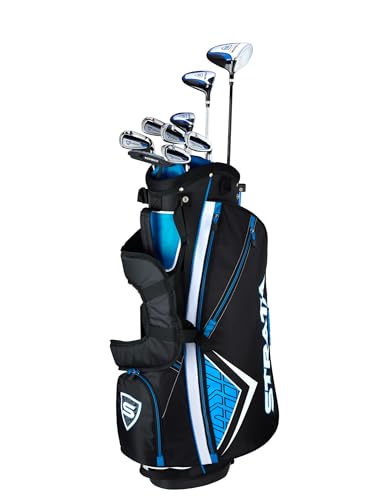
The men’s right-handed Strata is the most balanced starting point here. Its nine playable clubs comprise a driver, 3-wood, 5-hybrid, 6-9 irons, pitching wedge and putter. Two headcovers and a stand bag complete the package. The hybrid replaces the sort of long iron that many new golfers struggle to launch consistently.
There is no sand wedge, so bunker play and short shots that need more loft may eventually justify one additional purchase. That is a manageable gap and preferable to paying for several clubs a beginner may rarely use. The stand bag also makes it suitable for golfers who expect to carry rather than rely on a trolley.
- Buy it if: you want one sensible men’s right-handed set with no obvious distance gap.
- Skip it if: you need left-handed clubs or a shorter, longer or women-specific build.
- Main compromise: excellent overall coverage, but no dedicated sand wedge.
2. Fazer CTR25: best-value men’s set

The Fazer gives budget-conscious beginners ten clubs: driver, fairway wood, hybrid, 6-iron through sand wedge and a mallet putter. The woods use graphite shafts, while the oversize irons use steel shafts. That mixed construction is common in starter sets because it keeps the longer clubs lighter without making the whole package expensive.
Including both pitching and sand wedges gives it useful short-game coverage, and the stand bag has the expected storage, rain hood and carrying straps. The brand does not have Callaway or Wilson’s profile, but the exact club configuration is difficult to fault at this price.
- Buy it if: price matters but you still want a full men’s right-handed configuration.
- Skip it if: brand recognition and easier resale are priorities.
- Main compromise: generous club coverage for the money from a less established golf brand.
3. Wilson Profile Platinum: best premium package

Wilson’s Profile Platinum package is the upgrade choice for a beginner who expects to play regularly. It includes a driver, 5-wood, 5-hybrid, 6-iron through sand wedge and putter. That ten-club makeup covers tee shots, fairway distance, approaches and both pitching and bunker work without using hard-to-hit long irons.
The higher cost buys a recognised manufacturer and a coherent full package, but it does not remove the need to check the exact player specification. “Beginner” is not a fit category. Confirm handedness, length and shaft details on the selected variant before buying, especially if you are noticeably taller or shorter than average.
- Buy it if: you are committed to regular golf and want a branded set with both wedges included.
- Skip it if: you are still unsure whether golf will become a regular hobby.
- Main compromise: better brand appeal and coverage, but a meaningful premium over the Fazer and MacGregor.
4. MacGregor DCT4000: best cart-bag package

The DCT4000 is aimed at golfers who plan to use a trolley rather than carry. Its nine clubs include a driver, 3-wood, 4-hybrid, 6-9 irons, pitching wedge and putter. The woods and hybrid use regular-flex graphite shafts; the cavity-back irons use steel. The cart bag provides more storage but is less comfortable for walking a course without a trolley.
Like the Strata men’s set, it omits a sand wedge. A beginner can still chip with the pitching wedge, but a dedicated sand wedge is a logical first addition if bunkers become a recurring problem. Choose this package for the bag format and value, not because a cart bag is inherently better.
- Buy it if: you expect to use a trolley and want a recognised package near the budget end.
- Skip it if: you want to carry your bag or need a sand wedge from day one.
- Main compromise: useful full-course coverage and storage, but less walking flexibility.
5. Strata 11-Piece Women’s: best women’s set

This right-handed women’s Strata package contains seven clubs: driver, 5-wood, 5-hybrid, 7-iron, 9-iron, sand wedge and putter. The reduced iron count is intentional rather than a flaw. Wider gaps keep club choice simple while a wood, hybrid and two irons cover the main full-swing jobs.
The lightweight stand bag includes backpack-style straps, a rain hood and several pockets. There is no pitching wedge or mid-iron between 7 and 9, so a golfer who develops consistent distance gaps may add clubs later. As with every gender-labelled set, suitability depends on the individual rather than the label alone.
- Buy it if: you want a lighter right-handed package with simple club selection.
- Skip it if: the standard women’s length or shaft setup does not fit you.
- Main compromise: easy-to-understand coverage, but wider distance gaps than the men’s packages.
Head-to-head: which beginner set should you buy?
Choose the men’s Strata 12-Piece for the safest all-round recommendation. Choose the Fazer CTR25 when the budget matters more than the badge, or Wilson Profile Platinum when you want fuller short-game coverage and expect to play regularly. MacGregor is the better practical choice for trolley users, while the women’s Strata is the clearest lighter, reduced-club package.
The biggest mistake is choosing by piece count. Bags and headcovers can inflate that number, while a carefully chosen nine-club set may cover every shot a beginner needs. Count the actual clubs, identify the longest iron and check whether the set includes a pitching wedge, sand wedge or both.
Do not treat these five exact variants as interchangeable. Four are right-handed packages and the women’s Strata uses a different length and weight approach. If the variant does not match your hand or build, choose another configuration rather than adapting your swing around unsuitable equipment.
Choosing your first golf-club set
Start with useful gaps, not fourteen clubs
The Rules of Golf permit up to fourteen clubs, but beginners do not need to fill every slot. A driver, fairway wood or hybrid, several cavity-back irons, at least one wedge and a putter are enough to learn the game. Fewer overlapping choices can make decisions easier while distances are still developing.
Hybrids are especially useful because they replace low-lofted long irons that demand more speed and centred contact. For a fuller explanation of club roles, see our guide to choosing golf clubs and the comparison of cavity-back and game-improvement irons.
Check hand, length and shaft before brand
A right-handed golfer wears the glove on the left hand and normally swings with the club travelling towards the target from the right side. Do not infer hand from writing hand alone; use the side you naturally swing from. Length is also more nuanced than height, because arm length and posture matter. Golfers well outside the standard range should seek a basic static fitting before ordering.
Shaft-flex labels are not perfectly standardised between manufacturers. Regular, senior, stiff and women’s labels give a broad indication, but there is no universal swing-speed threshold that makes one label correct. Our shaft-flex guide explains the trade-offs without pretending the label alone is a fitting.
Choose the bag for how you will play
A stand bag has fold-out legs and backpack straps, making it the flexible choice for carrying, range sessions and occasional trolley use. A cart bag usually provides more storage and a stable trolley-facing layout but is awkward to carry for eighteen holes. Beginners who have not decided should usually choose a stand bag.
Second-hand clubs, fitting and essential extras
When second-hand makes sense
Used game-improvement irons and putters can offer good value, but building a complete mixed bag requires more knowledge than buying a package. Check shaft damage, loose heads, grip condition and whether the loft gaps make sense. Avoid assuming age alone determines performance or value. Condition, specification and authenticity matter more.
Check every club rather than treating the bag as one item. Matching brand names do not prove the shafts, lengths or lie angles match, and a missing seven-iron can be surprisingly expensive to replace. Ask for clear photos of the faces, grooves, ferrules and shaft labels. Our dedicated guide to buying second-hand golf clubs gives a fuller inspection list.
For a first purchase, a current package set provides a simpler baseline and consistent return route. Second-hand becomes attractive when you know which club needs upgrading. Clean equipment carefully and inspect it regularly; our guide to cleaning clubs and grips covers the basics.
Do beginners need a fitting?
Most beginners do not need an expensive dynamic fitting before developing a repeatable swing. A basic check of hand, club length, posture and grip size is still worthwhile, particularly for very tall or short players or anyone with mobility limitations. A more detailed fitting becomes useful when technique stabilises and a specific upgrade is planned.
If possible, hit a few balls before buying. You are not looking for tour-level launch numbers: check whether you can address the ball comfortably, whether the club feels manageable and whether repeated shots start reasonably close to the centre of the face. A retailer or professional should explain any recommended length or lie adjustment instead of relying on height alone.
What else do you need?
A complete club set is the largest purchase, but it is not the whole starting kit. Keep the first accessories functional and inexpensive. You can replace balls, gloves or shoes once you understand what you actually use; there is little benefit in matching a tour player’s bag before your first round.
- Golf balls: start with affordable balls you will not mind losing.
- Tees and pitch-mark tool: small essentials that rarely come with a club package.
- Glove: useful for grip and wet conditions, but check hand carefully.
- Waterproof layer: more valuable on a British course than an extra long iron.
- Shoes: prioritise stable grip and comfort rather than tour styling.
Frequently Asked Questions
What is the best golf-club set for a beginner?
The Callaway Strata 12-Piece men’s right-handed package is the best overall set here. It covers the main distance gaps with nine clubs and a stand bag without relying on difficult long irons.
How much should a beginner spend on golf clubs?
Current complete packages in this guide range from roughly the low £200s to the mid £400s. Spend more only when the exact fit, club makeup and expected playing frequency justify it.
How many clubs does a beginner need?
Around seven to ten well-spaced clubs can cover a beginner’s needs. The fourteen-club rule is a maximum, not a shopping target.
Should a beginner choose graphite or steel shafts?
Graphite is common in drivers, woods and hybrids because it is lighter. Steel remains common in irons. The right choice depends on the player and exact shaft, not material alone.
Are package sets better than second-hand clubs?
Package sets are easier for a first purchase because the gaps and bag are already organised. Used clubs can offer excellent value once you know the specification and individual upgrades you need.
Do beginners need custom-fitted clubs?
Most do not need an expensive full fitting immediately, but a basic hand, length and grip check is sensible. Players outside standard proportions or with physical limitations should get advice before buying.
The bottom line
The Callaway Strata 12-Piece is the strongest all-round beginner package for men who need a standard right-handed set. Choose the Fazer CTR25 for lower-cost full coverage, Wilson Profile Platinum for a more premium branded package, MacGregor DCT4000 for trolley use, or the women’s Strata when its lighter right-handed specification fits the player.