The right golf wedge setup is usually three clubs, not one magic lob wedge. For most UK golfers, the best golf wedges UK setup is a forgiving gap or approach wedge, a dependable sand wedge, and a lob wedge only if you have the technique and practice time to use it.
In This Article
- Quick Answer: The Wedges I Would Buy
- How to Build Your Wedge Gapping
- Best Golf Wedges UK: Product Picks
- Bounce and Grind Without the Nonsense
- Matching Wedges to Your Irons
- UK Course Conditions and Wedge Choice
- Common Wedge Buying Mistakes
- Frequently Asked Questions
Quick Answer: The Wedges I Would Buy
If I were building a sensible wedge setup in 2026, I would start with a 50 or 52 degree approach wedge and a 56 degree sand wedge. I would only add a 58 or 60 degree lob wedge after checking the pitching wedge loft in the iron set and being honest about how often I practise short-game shots.
For most mid-handicap golfers, the best overall buy is the Cleveland CBX 4 ZipCore. It has more help across the face than a traditional blade wedge, still looks tidy behind the ball, and usually sells for about £109-£139 from American Golf, Clubhouse Golf or Scottsdale Golf depending on loft and shaft. If you play game-improvement irons, this is the wedge I would try first.
If you want the classic tour-style option, the Titleist Vokey SM10 is still the benchmark. UK retailers have been selling SM10 wedges around £139-£169 since SM11 arrived, while newer SM11 models sit closer to £179-£219. The Vokey is brilliant if you know your loft, bounce and grind. It is less forgiving if you are guessing.
My budget pick is a Wilson Harmonized or Fazer XR style wedge from American Golf, Amazon UK or Sports Direct, usually around £35-£60. The feel is nowhere near Vokey or Cleveland, and the grooves will not stay sharp forever, but a cheap 56 degree wedge is better than trying to play every greenside shot with a pitching wedge.
Best overall for most golfers
Cleveland CBX 4 ZipCore, ideally in 50 and 56 degrees, suits the widest range of UK club golfers. The cavity-back shape gives a little more stability when you catch the ball slightly high or towards the toe. That matters because most amateurs miss wedge shots by strike, not by choosing the wrong finish on the back of the club.
Best for confident ball-strikers
Titleist Vokey SM10 or SM11 is the one to buy if you already deliver the club consistently. You get more loft, bounce and grind options, which is excellent if you know what you want and mildly dangerous if you are just copying a tour player.
Best cheap first wedge
A Wilson Harmonized 56 degree wedge at about £40-£50 is a perfectly sensible starting point for beginners. I would rather see a new golfer buy one cheap sand wedge, learn to chip and escape bunkers, then upgrade later than spend £450 on three specialist wedges before they can control low point.
How to Build Your Wedge Gapping
Wedge buying starts with your pitching wedge loft. Not the word printed on the sole. The actual loft. Modern game-improvement pitching wedges can be as strong as 41-43 degrees, while older or more traditional sets may sit around 46-48 degrees. That difference changes everything.
If your pitching wedge is 43 degrees and your next wedge is a 56, you have a huge 13 degree gap. That is where awkward half-swings and thinned approaches come from. A better setup would usually be 43 pitching wedge, 48 gap wedge, 52 approach wedge and 56 sand wedge, or 43, 50 and 56 if you want fewer clubs.
The R&A Rules of Golf limit you to 14 clubs, so every extra wedge has to earn its place. Carrying four wedges can make sense, but not if it forces you to drop a hybrid you use twice every round.
If the whole set still feels muddled, start with the broader guide to choosing golf clubs and then come back to wedge gaps once the long end of the bag is settled.
The common three-wedge setup
For many golfers, three specialist scoring clubs beyond the pitching wedge is plenty:
- Gap or approach wedge, 48-52 degrees: full and three-quarter shots from roughly 70-105 yards, depending on swing speed.
- Sand wedge, 54-56 degrees: bunkers, short pitches, rough around the green and controlled chips that need height.
- Lob wedge, 58-60 degrees: short-sided shots, firm bunkers, high soft pitches and recovery shots where rollout is limited.
I would not buy a lob wedge first. Buy the gap and sand wedge first. A 60 degree wedge looks useful, but it magnifies poor contact. The average player saves more shots by hitting predictable 50 and 56 degree shots than by trying to flop a ball over a bunker once a month.
How big should the gaps be?
Aim for 4-6 degrees between wedges. That usually gives manageable distance gaps without needing four different full swings. A neat set might be 46, 50, 54 and 58. Another might be 44, 50 and 56 for a golfer who wants one fewer club at the scoring end.
Distance matters more than loft labels. If your 50 degree wedge flies 95 yards and your 56 flies 75, that 20-yard gap is workable. If the gap is 35 yards, you need another wedge or better partial-swing control.
Test with real balls
Range balls can make wedge distances messy because they are often old, hard and inconsistent. Use your normal golf balls for at least one short-game session before locking in lofts. The ball you play also affects spin and stopping power; our golf ball types guide explains why a distance ball and a urethane tour ball behave differently on half wedges.
Best Golf Wedges UK: Product Picks
The best golf wedges UK buyers should shortlist depends on ability, iron type and course conditions. A scratch golfer and a 24-handicapper should not automatically buy the same head, even if the tour-style wedge looks prettier.
Best golf wedges UK: quick comparison
| Wedge | Best for | Typical UK price | Where to look |
|---|---|---|---|
| Cleveland CBX 4 ZipCore | Most mid and high handicappers | £109-£139 | American Golf, Clubhouse Golf, Scottsdale Golf |
| Titleist Vokey SM10 | Better players wanting grind choice | £139-£169 | Scottsdale Golf, Clarkes Golf, pro shops |
| TaylorMade MG4 | Spin and a compact tour look | £119-£159 sale-dependent | American Golf, GolfOnline, McGuirks |
| Callaway Jaws Raw or Opus | Soft feel and high spin | £129-£179 | Clubhouse Golf, GolfOnline, American Golf |
| Wilson Harmonized | Cheap first sand wedge | £35-£60 | Amazon UK, Sports Direct, American Golf |
Cleveland CBX 4 ZipCore
The Cleveland CBX 4 ZipCore is my first recommendation for normal club golfers because it behaves more like a forgiving iron than a tiny blade. The sole has enough help for heavy strikes, the cavity gives stability, and the head does not look huge.
It suits players using cavity-back irons, strong-lofted game-improvement sets, or anyone who finds a blade wedge harsh on slight mishits. I would buy the 50 degree and 56 degree first. If you later add a lob wedge, try the 58 rather than jumping straight to 60.
Titleist Vokey SM10 or SM11
Vokey wedges are popular for a reason: the grind options are excellent, the shape is clean, and the feel is consistent. The trade-off is that they punish poor choices. A low-bounce 60 degree wedge on soft UK parkland can dig like a spade if your technique is steep.
The SM10 is now the value play where retailers still have stock, often around £139. SM11 costs more, commonly £179-£219 depending on finish and shaft, so I would only pay the premium if the exact loft and grind you want is unavailable in SM10.
TaylorMade MG4
TaylorMade MG4 wedges are a good fit if you like a compact shape and want plenty of spin on partial shots. They often appear in sales around £119-£159, which puts them below new Vokey pricing without feeling cheap.
The raw face will not bother some players, but it is worth knowing before you buy. It can mark and darken with use. That is normal, not a defect. If you want a club that looks showroom-clean for years, buy a chrome finish from another range.
Callaway Jaws Raw or Opus
Callaway wedges suit golfers who want a soft feel and a slightly friendlier shape than some sharper tour heads. Jaws Raw models have often been discounted as newer Opus stock comes in, so used and clearance prices can be good.
Expect around £129-£179 new depending on model and retailer. If you already play Callaway irons, they are an easy brand match, though you should still check loft gaps rather than buying the same badge by habit.
Wilson Harmonized
Wilson Harmonized wedges are not glamorous. The finish is basic, the shaft options are limited and the feel is firmer. Still, at roughly £35-£60, they are useful for beginners, occasional golfers and anyone who wants to learn what a 56 degree wedge can do before spending proper money.
I would buy one cheap 56, practise bunker shots and basic chips for a month, then decide whether wedge upgrades belong above new irons, shoes or lessons on the priority list. Our beginner club-count guide is useful if you are trying to keep the bag simple.
Bounce and Grind Without the Nonsense
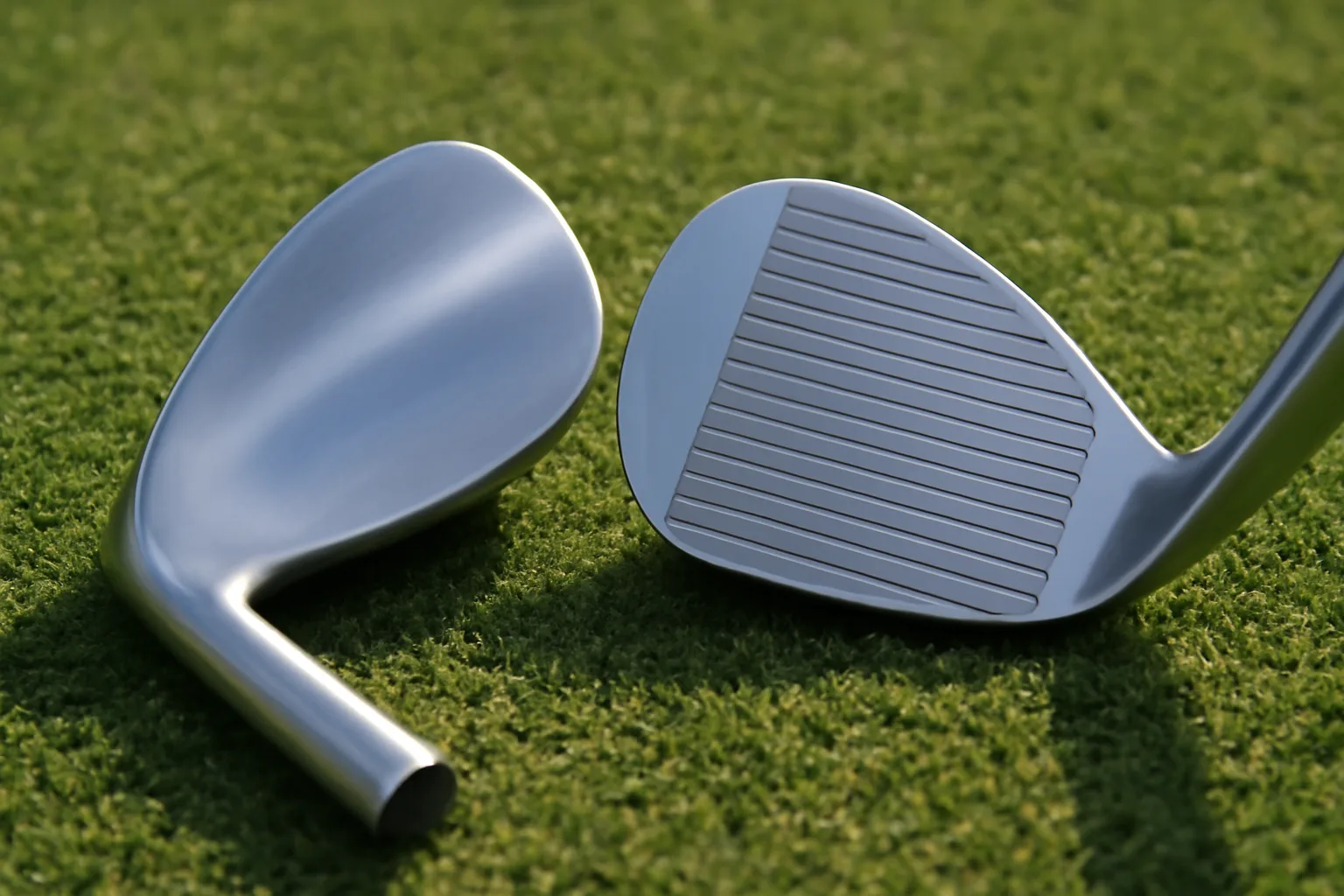
Bounce is the angle between the leading edge and the lowest part of the sole. In plain English, it controls how much the wedge resists digging. More bounce helps the sole skim through sand, wet turf and fluffy lies. Less bounce lets the leading edge sit closer to the ground for tight lies and firm conditions.
Grind is the shaping of the sole. Heel relief, toe relief and trailing-edge relief all change how the wedge behaves when you open the face or change shaft lean. It sounds technical because it is, but most golfers can simplify the decision.
Choose bounce by delivery
If you take deep divots, play on soft courses, or often hit wedge shots heavy, choose more bounce. A 56 degree wedge with 10-14 degrees of bounce is your friend. It will not fix bad technique, but it gives the club a chance to slide rather than bury.
If you sweep the ball, play on firm links turf, or like nipping chips from tight lies, lower bounce can work. Be careful. Low bounce feels brilliant when struck well and horrible when the leading edge arrives early.
Choose grind by shot style
If you mostly play square-face chips, pitches and bunker shots, choose a standard or full sole. It is more predictable. If you often open the face for high shots, a C, M or similar relieved grind gives you more options.
That is why the existing wedge bounce and grind explainer is worth reading before ordering three Vokeys. This buying guide can point you in the right direction, but the detailed grind decision deserves its own page.
The safe default
The safest UK default is a mid-bounce 50 or 52 degree gap wedge and a higher-bounce 56 degree sand wedge. That combination handles soft approaches, damp rough, parkland bunkers and ordinary chipping without asking you to be Seve.
For a lob wedge, I would choose 58 degrees with mid bounce before a 60 degree low-bounce model. It gives nearly the same height with less punishment.
Matching Wedges to Your Irons
Your wedge setup should flow from your irons. If your pitching wedge is part of a chunky game-improvement set, a tiny blade-style 50 degree wedge may create an awkward jump in feel, shaft weight and forgiveness.
Check three things before buying:
- Pitching wedge loft: find the actual loft on the manufacturer spec page, not just the label.
- Shaft weight: a heavy wedge shaft can feel strange if your irons have light graphite shafts.
- Head style: cavity-back irons pair well with forgiving wedges; blade irons pair naturally with compact wedges.
Approach wedge or set gap wedge?
Many iron sets offer a matching gap wedge. For newer golfers and high handicappers, that can be the better 48-50 degree club because it feels like the rest of the irons. You use it for full shots more than delicate greenside shots, so forgiveness matters.
Specialist wedges start to make more sense from 52 degrees down, where you are opening the face, playing from bunkers and controlling spin. A mixed setup is normal: set gap wedge, specialist 54 or 56, optional specialist 58.
Shaft and lie checks
A wedge that is too upright can pull short shots left. A shaft that is too heavy can make distance control clumsy. You do not need a full tour fitting, but a basic loft and lie check at a pro shop is usually £5-£10 per club, and many shops include it when you buy.
If you already had an iron fitting, use those specs as a starting point. Our custom fitting guide explains where fitting saves strokes and where it becomes expensive tinkering.
UK Course Conditions and Wedge Choice
UK wedge choice is seasonal. A wedge that feels perfect on firm summer fairways can be a liability on wet November turf. That is why I prefer a forgiving, mid-to-high bounce sand wedge for most club golfers.
Parkland golf
Most UK parkland courses get soft for part of the year. The ball sits down, the turf takes a divot, and bunkers can be heavy after rain. Choose a 56 degree wedge with enough bounce to stop the leading edge digging. Cleveland CBX, Vokey F/S/D-style options and many Callaway cavity or wider-sole wedges are useful here.
Links golf
On firm links turf, the ball can sit tight against the ground, and a wide high-bounce sole can feel clumsy on clipped shots. A 50 or 52 degree wedge with mid or lower bounce becomes more useful. You may also play more bump-and-runs with a 9-iron or pitching wedge, so the lob wedge sees less action.
Winter golf
Winter golf exposes bad wedge choices. Mud on the ball, wet grips, plugged lies and inconsistent bunkers all make delicate shots harder. Fresh grooves help, but so does restraint. In winter, I would rather play a lower, safer chip with a 50 degree wedge than try to land a 60 degree shot on a sixpence.
The R&A equipment rules also matter if you compete seriously. Most modern wedges from major brands conform, but older used wedges and unusual chipping clubs are worth checking against the R&A club conformance guidance before you rely on them in competitions.
Common Wedge Buying Mistakes
Used wedges can be good value, but they wear differently from drivers and irons. A five-year-old driver may still perform close to new. A heavily used sand wedge can look tidy in photos and still have tired grooves.
Groove condition
Run a fingernail lightly across the grooves. They should still feel defined. If the face looks polished smooth in the hitting area, walk away unless the price is throwaway cheap. Fresh grooves matter most in wet rough and partial shots where you need spin.
Used Vokey, Cleveland, Callaway and TaylorMade wedges often sit around £45-£100 from Golfbidder, eBay UK, Facebook Marketplace and pro-shop trade-in racks. That can be a bargain if the face is clean. It is not a bargain if you save £40 and lose stopping power all season.
Loft and bounce stamp
Make sure the loft and bounce stamp is visible and matches what you need. A random 60.04 wedge might sound exciting, but low bounce is not the easiest choice for soft turf or steep swings.
If the listing only says “sand wedge” without loft, ask before buying. Older sand wedges can be 54, 56 or 58 degrees. That matters for gapping.
Shaft, length and grip
Check whether the wedge has a standard wedge shaft, a graphite shaft, or something unusual from a custom order. A grip replacement costs around £8-£15 fitted, which is fine if you budget for it. A badly mismatched shaft is harder to justify.
For beginners, used wedges are most attractive when buying from a retailer with condition grading and returns. For better players chasing an exact grind, used can work, but only if the face condition is clean enough to justify the risk.
The most common wedge mistake is buying by loft ego. A 60 degree wedge feels like a short-game cheat code until you thin one through the back of the green and start negotiating with the next tee.
Buying too much loft too soon
Most golfers need a good 56 before they need a 60. A sand wedge can play chips, bunkers, pitches and partial approaches. A lob wedge is more specialised and less forgiving.
If you currently carry only a pitching wedge, buy a 50 or 52 and a 56 first. Add the lob wedge later if you keep finding shots where the 56 cannot stop quickly enough.
Ignoring the pitching wedge loft
This one causes messy distance gaps. A modern pitching wedge stamped “P” may be closer to an old 9-iron. If you do not check it, you may buy a 52 and discover it flies almost the same distance as your pitching wedge, or a 56 and leave a huge gap.
Look up the iron specs online or ask your pro shop to measure it. Ten minutes here saves years of awkward half-swings.
Copying tour setups
Tour players often carry 46, 50, 54 and 60, or similar. They practise wedge control constantly, play on prepared turf, and know exactly how each grind reacts. Copying the lofts without the practice is a shortcut to confusion.
There is nothing wrong with four wedges if you use them. But if one never leaves the bag, it is taking the place of a fairway wood, hybrid or extra iron that might help more often.
Buying three different models at once
Mixing wedges can work, but do it for a reason. A forgiving gap wedge and a specialist sand wedge make sense. Three random sale wedges with different shafts, head weights and sole shapes rarely feel coherent.
My favourite setup for a typical improving golfer is boring on purpose: forgiving 50, forgiving or mid-bounce 56, then a 58 only after a short-game lesson. It is not flashy. It saves shots.
Frequently Asked Questions
What wedges should an average golfer carry? Most average golfers should carry a gap wedge around 50 or 52 degrees and a sand wedge around 56 degrees. Add a 58 degree lob wedge only if you practise enough to use it reliably.
Is a 60 degree wedge hard to hit? Yes, compared with a 56 degree wedge. A 60 degree wedge needs cleaner contact and better distance control, so it can cost shots for beginners and high handicappers.
What is the best golf wedges UK setup for a beginner? A beginner should usually start with a 50 or 52 degree gap wedge and a forgiving 56 degree sand wedge. A Wilson budget wedge or Cleveland CBX-style head is more sensible than a low-bounce tour lob wedge.
How much should I spend on golf wedges? Budget wedges start around £35-£60, good forgiving wedges are usually £100-£140, and premium tour-style wedges cost about £139-£219. Spend more once you know the loft and bounce you need.
How often should wedges be replaced? Heavy players may notice groove wear after 75-100 rounds, especially on sand wedges. Occasional golfers can keep wedges much longer, but replace them when the face looks polished and chips stop checking.
Should my wedges match my irons? Your gap wedge can sensibly match your irons, especially if you use it for full shots. Sand and lob wedges can be specialist models because they handle bunkers, chips and open-face shots.