For a mid-handicapper, how to break 90 golf comes down to refusing to donate shots. If you can keep the ball in play, avoid the heroic recovery, and turn half your bad holes into bogeys instead of doubles, the scorecard starts looking very different. The target is not perfect golf. It is controlled golf with fewer disasters.
In This Article
- How To Break 90 Golf: The Real Target
- Build A Bogey-First Scorecard Plan
- Choose Safer Tee Shots Without Playing Scared
- Make Approach Shots Boring On Purpose
- Save Shots Around The Green
- Practise For 90, Not For The Range
- Where Equipment And Lessons Actually Help
- Frequently Asked Questions
How To Break 90 Golf: The Real Target
To shoot 89 on a par-72 course, you can make 17 bogeys and one par. That is the whole frame. You do not need four birdies, a 280-yard driver, or a wedge game that belongs on Sky Sports. You need to stop turning ordinary mistakes into sevens.
That is why the first question is not “how do I hit it better?” It is “where am I losing the avoidable shots?” For most mid-handicap golfers, the list is painfully familiar:
- Penalty balls: one reload from the tee can become a triple before you have walked 50 metres.
- Short-sided misses: attacking tucked pins leaves chips with no green to work with.
- Three-putts: long putts left six feet short turn safe greens into stress.
- Hero recoveries: one attempted miracle through trees creates the next problem.
- Poor club choice: taking a perfect-strike club instead of a normal-strike club costs greens.
The how to break 90 golf plan is built around those leaks. Fix one and you may save two shots. Fix three and 89 becomes realistic even with an average swing.
Track the right numbers
Do not overcomplicate stat tracking. You do not need a £299 Arccos system or a £200 Garmin watch to start, though both can help if you like data. A £3 notebook from WHSmith or a free notes app is enough.
After each round, write down:
- Penalty shots: balls out of bounds, lost balls and water.
- Three-putts: count them without excuses.
- Failed chips: any chip that does not reach the green or races across it.
- Double bogeys or worse: note what caused the first problem.
After five rounds, patterns appear. If six of your doubles start from driver, the answer is not another putting drill. If you hit greenside chips fat twice a round, buying a new driver is just retail therapy with a headcover.
Know the rules of the scoring game
Stableford can hide bad holes because you pick up and move on. Stroke play does not. The R&A’s Rule 3 sets out the basic competition structure, and the important bit for this article is simple: every stroke counts. Your break-90 strategy has to respect that.
That does not mean playing timidly. It means knowing when one shot of caution protects three shots of damage.
Build A Bogey-First Scorecard Plan
Most golfers chasing 90 still think in pars. That is understandable, but it creates bad decisions. A bogey-first plan gives you permission to play the hole in the right order.
On a par 4, bogey golf looks like this:
- Get the tee shot in play: not necessarily long, just playable.
- Advance the second shot near the green: or onto the green if the club suits the yardage.
- Put the third shot somewhere puttable: middle of green beats cute.
- Two-putt: accept the bogey and leave.
That sounds unglamorous because it is. It also works. The golfer who makes 12 bogeys, four pars and two doubles shoots 88. The golfer who chases every flag, makes six pars and five doubles shoots 91 and spends the car journey blaming “one bad hole”.
Sort holes before you play them
Before the round, split the course into three groups:
- Green holes: holes where you can be positive because the tee shot suits your eye.
- Yellow holes: holes where bogey is fine and par is a bonus.
- Red holes: holes with out of bounds, water, a narrow tee shot or a long forced carry.
On red holes, your aim is to leave with bogey or better. That may mean hybrid from the tee, laying up short of a bunker, or aiming at the fat side of the green. It is not cowardice. It is knowing where the scorecard bleeds.
Stop chasing the shot you hit once
Mid-handicap strategy should be based on your normal shot, not your best shot. If your 7-iron can go 150 yards but usually carries 138-142, it is a 140-yard club for scoring purposes. The 150-yard memory is not a yardage; it is a souvenir.
This is where a rangefinder or GPS watch helps. A decent laser rangefinder such as the Zoom Focus X or Mileseey models often costs about £90-£160 on Amazon UK, while a Garmin Approach S12 is usually around £149-£179 at American Golf or Amazon UK. Useful tools, but only if you aim at sensible targets. Exact yardage to a bad target is still bad golf.
For more detail on distance tools, see our guides to golf rangefinders and reading rangefinder slope, pin lock and jolt.

Choose Safer Tee Shots Without Playing Scared
The tee shot sets the ceiling for the hole. It also sets the floor. If your driver brings out of bounds, trees and reloads into play, you have to earn the right to hit it.
Use driver when the miss is playable
Driver is not banned in a break-90 plan. Some golfers hit driver more confidently than a 3-wood. If your driver miss finishes in the rough with a view of the green, keep using it. If your driver miss is a lost ball, it is costing too much.
The decision is not “driver or no driver”. It is:
- Where is the widest landing area? Aim there, not at the middle of the fairway by default.
- Which side is dead? Favour the opposite side even if it leaves a longer approach.
- Can I reach trouble? If a fairway bunker is 210 yards away and your hybrid carries 195, that matters.
- What score does this hole need? On stroke-index 2, bogey is not a failure.
We have seen this play out in club medals: the player who hits hybrid, 7-iron, wedge and two putts often beats the player who hits driver, provisional, wedge, bunker shot and a frustrated three-putt. Less exciting. Lower score.
Pick a real target
“Down there” is not a target. Pick a tree, a bunker edge, a chimney, a stripe in the fairway, anything specific. A vague aim creates a vague swing.
If you slice, aim at a target that allows for it without starting the ball at danger. If you hook, do the same on the other side. You are not trying to fix the whole swing during the round. You are managing the shot pattern you brought to the first tee.
For driver-specific work, our guide on hitting driver straighter and farther is the technical companion to this strategy piece.
Make Approach Shots Boring On Purpose
Approach shots are where many 90-chasers get greedy. They fire at flags tucked behind bunkers, choose the club that only works with a perfect strike, and then act surprised when bogey becomes double.
Aim at the biggest safe target
If the flag is on the right behind a bunker, the target is often the middle-left of the green. If the pin is back and long is dead, take the club that cannot go long with a normal strike. If short leaves an easy chip uphill, short might be fine.
The middle of the green is underrated because it feels too simple. From 140 yards, a mid-handicap golfer hitting the green at all has done a good job. Two-putt and move on.
Club up more often
Most amateur misses are short. Not all, but enough to matter. Cold UK air, soft fairways, wet grips and range-ball optimism all make club selection awkward.
Try this for five rounds: when you are between clubs, take the longer one and make a balanced swing. Not a decel steer. A normal, committed swing with the longer club. You may be surprised how many shots finish pin-high instead of in the front bunker.
If your irons are a poor fit, a lesson or fitting may help, but check the basics first. Our articles on choosing golf clubs, golf irons and shaft flex explain the equipment side without pretending clubs fix every strike.
Take the trouble out of play
You are allowed to miss intentionally. If there is water short and right, aim long-left if that leaves grass. If the green is tiny and surrounded by bunkers, laying up to a favourite wedge distance can be smarter than trying to thread a 5-iron onto a shelf.
A bogey made calmly from the safe side feels dull on the day. It feels brilliant when you add the card up.
Save Shots Around The Green
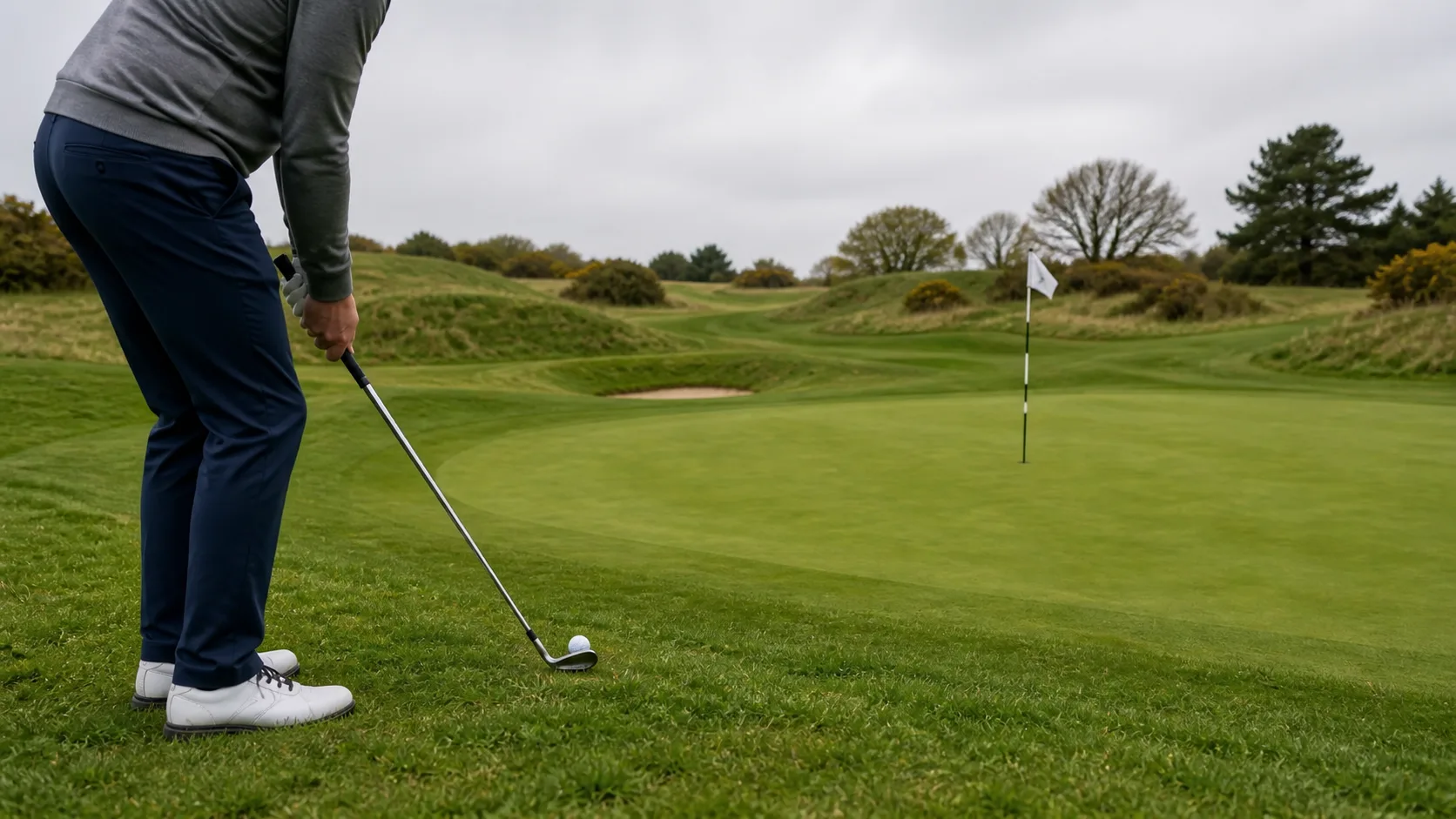
To break 90, you do not need tour-level short game. You need a chip that gets on the green, a bunker shot that escapes first time often enough, and lag putting that removes three-putts.
Use one reliable chip first
Many mid-handicappers own six short-game shots and trust none of them. Start with one stock chip: ball slightly back, weight forward, hands quiet, landing spot on the green. Use a pitching wedge, gap wedge or 9-iron depending on green speed and carry.
The goal is not to hole it. The goal is to leave a putt. A chip that finishes 20 feet away is annoying. A chip that stays in the rough is expensive.
Practise bunker escapes, not spin
If bunkers cost you two or three shots at a time, spend practice there. You only need to splash the ball onto grass and accept the putt. A one-hour short-game lesson at a UK club is often about £35-£70, and if it fixes bunker contact it can be better value than a new wedge.
For the basics, our bunker guide, How to Hit Out of a Bunker Every Time, is worth pairing with this plan.
Lag putt like a grown-up
Three-putts are usually distance-control failures. From 30 feet, your target is not the hole. It is a dustbin-lid circle around the hole. If the first putt finishes inside a metre, you have done the job.
The England Golf handicapping guidance is a useful reminder that scoring improvement is measured over real rounds, not range sessions. Your handicap comes down when the big numbers disappear. Lag putting is one of the quietest ways to make that happen.
Practise For 90, Not For The Range
Range practice can help, but only if it looks like golf. Smashing 60 drivers in a row teaches you to smash 60 drivers in a row. It does not teach you to hit a tee shot after waiting eight minutes in waterproofs with a card in your pocket.
Use a 60-minute practice split
If you have one hour, use it like this:
- 10 minutes putting start lines: short putts from one to two metres.
- 15 minutes lag putting or chipping: choose the weakest short-game area.
- 15 minutes wedges: half, three-quarter and stock pitching distances.
- 15 minutes approach clubs: 8-iron to hybrid, changing target every shot.
- 5 minutes tee-shot rehearsal: three balls with the club you will use on the first hole.
Range balls are usually about £6-£10 for 50-100 balls in the UK. A small bucket used properly beats a large bucket sprayed mindlessly.
Play consequence games
Practise like the score matters:
- Nine-ball tee game: pick nine fairway targets. Score one point for playable, two for fairway, zero for lost.
- Up-and-down ladder: chip one ball from nine different spots and putt each out.
- Two-putt challenge: place balls at 6m, 9m, 12m, 15m and 18m. No three-putts allowed.
- Wedge landing game: choose three carry numbers and hit three balls to each.
You will learn more from 25 balls with consequence than 100 balls with no target.
Rehearse your bad-weather plan
UK golf means wind, drizzle and soft lies. Have a lower tee shot, a punchy 7-iron and a bump-and-run option. You do not need to master links golf overnight, but you need a shot that keeps moving forward when the normal one feels risky.
Where Equipment And Lessons Actually Help
Equipment can help you break 90, but only when it solves a specific problem. Buying gear because the last round hurt is expensive therapy.
Spend money where it removes a shot leak
Good places to spend:
- One lesson on your biggest miss: £35-£70 is typical at many UK clubs, more at premium venues.
- A forgiving driver fitting: useful if your current driver is too low-lofted or has the wrong shaft.
- A gap wedge: often £80-£140 new from American Golf, Clubhouse Golf or Scottsdale Golf, less used.
- A reliable glove: £10-£20 for a FootJoy, Srixon or Callaway glove can help grip in wet weather.
- Golf balls that suit your miss: Srixon AD333 or Titleist TruFeel often sit around £20-£28 per dozen.
Bad places to spend: a 3-wood you cannot launch, a low-spin tour ball that makes your slice worse, or a wedge grind you do not understand.
Lessons beat random swing tips
If you are stuck at 92-98, a professional can often spot one priority quickly. Maybe your alignment is miles right. Maybe your grip makes the face open. Maybe your short backswing bunker fear is obvious from two swings.
One lesson will not turn you into a scratch golfer, but it can give you a fixable priority. That is worth more than watching 14 videos and blending them into one confused swing thought.
Keep the bag simple
Carry clubs you trust. If your 4-iron is decorative, replace it with a hybrid or leave it at home. If you never hit lob wedge cleanly, stop choosing it just because the ball is near the green.
A break-90 bag should have answers, not ornaments.
Bottom Line
Breaking 90 is a strategy project before it is a swing project. You need a bogey-first plan, safer tee-shot decisions, boring approach targets, a reliable chip, fewer three-putts and practice that looks like the course.
The quickest route is to track doubles and penalties for five rounds, then attack the biggest leak. If driver costs you four shots, change the tee plan. If chips stay in the rough, build one stock chip. If three-putts keep appearing, practise distance control until the first putt scares the hole more often.
You can break 90 without playing beautiful golf. You just cannot keep giving shots away.
Frequently Asked Questions
What handicap usually breaks 90? A golfer around an 18 handicap should be capable of breaking 90 on a par-72 course, but it depends on course difficulty and how many big numbers they make. Plenty of 20-plus handicappers break 90 on good days by keeping the ball in play.
Do I need to hit driver to break 90? No. You need tee shots that stay playable. If driver is reliable, use it. If it creates penalties, use hybrid, 5-wood or long iron on tighter holes until the driver behaves.
What is the fastest way to break 90 in golf? Track penalty shots, three-putts and failed chips for five rounds, then practise the biggest leak. For most golfers, removing penalties and three-putts drops scores faster than chasing extra distance.
How many pars do you need to break 90? On a par-72 course, 17 bogeys and one par gives you 89. More pars help, but avoiding double bogeys matters more than chasing birdies.
Should I take lessons to break 90? A lesson is worth it if you have a repeat problem such as a slice, bunker fear or fat chips. One focused UK lesson at about £35-£70 can save more shots than another club bought on impulse.
What should I practise most to break 90? Practise tee-shot control, basic chipping and lag putting. Those areas stop big numbers. Range work helps, but only if you change targets and use consequence games rather than hitting the same club repeatedly.