The golf GPS watch vs laser rangefinder choice comes down to the information you need. A watch shows the shape of the hole and useful distances without needing a visible target; a laser gives an exact reading to the object you aim at. For most club golfers, a GPS watch is the better single-device choice. For confident players who want a precise flag distance before choosing a club, the laser wins.
In This Article
- The short answer
- How both devices work
- Distance information compared
- Speed and ease of use
- Course mapping and blind shots
- Battery and cost
- Competition rules
- Which one to buy
- Frequently asked questions
Golf GPS Watch vs Laser Rangefinder: The Short Answer
If you want one answer, buy a GPS watch. It is quicker to glance at, works when the flag is hidden and gives front, middle and back distances that are more useful than a seductive but false sense of precision. Our comparison is based on the published information each format can provide, not a claim that either device magically improves club selection.
Choose a laser rangefinder instead when you already know your carry distances, regularly attack accessible pins and want the distance to a particular flag, bunker lip or tree. A laser is also appealing if you dislike wearing a watch or do not want another device to charge.
| Decision | GPS watch | Laser rangefinder |
|---|---|---|
| Best for | Fast course context | Exact visible targets |
| Typical reading | Front, middle and back of green | Distance to the object aimed at |
| Blind target | Yes, if mapped | No |
| Hazard overview | Strong on suitable maps | One target at a time |
| Main weakness | Map and satellite tolerances | Needs a steady, clear line of sight |
There is no universal accuracy winner because the two devices do not measure the same thing. A laser may give a tighter number to a visible flag. A watch may give the more useful number when the smart shot is to the safe part of a green or short of a hazard.
How GPS Watches and Laser Rangefinders Work
A GPS watch locates you on a course map
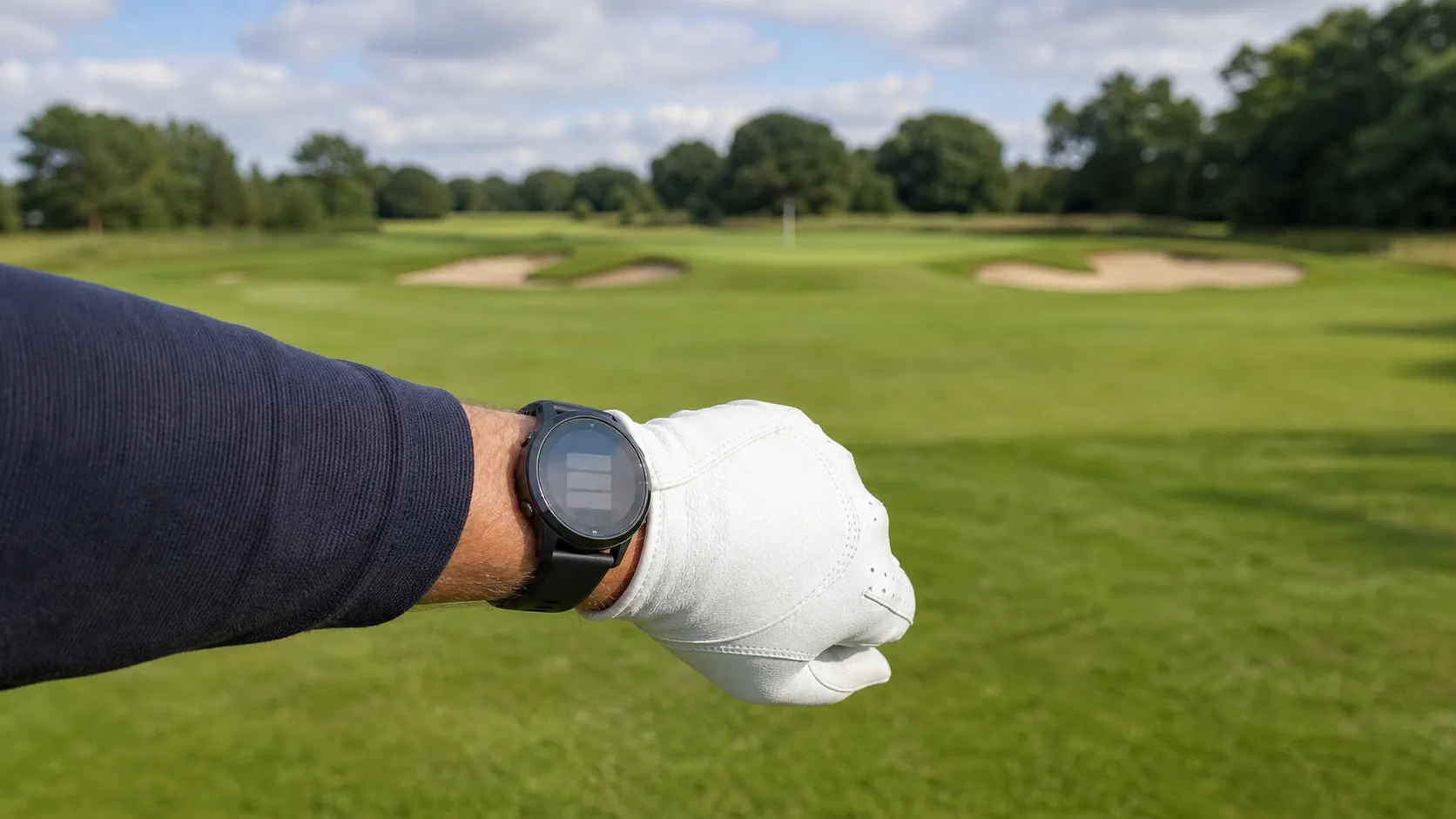
A golf GPS watch uses satellite positioning to estimate where you are, then compares that position with stored course data. Basic models show distances to the front, middle and back of the green. Better watches add hazard locations, lay-up points, scoring and shot tracking.
That distinction matters. The watch is not measuring the flag. It is calculating the distance between your location and mapped points. If the pin is tucked five metres from the front edge, the middle number is not the flag distance—and it does not pretend to be.
The appeal is context. You can glance at your wrist from the rough, beside a tree or on a hole where the green surface is hidden. Our guide to the best golf GPS watches explains how current watch features differ without turning this comparison into another product shortlist.
A laser measures a visible object
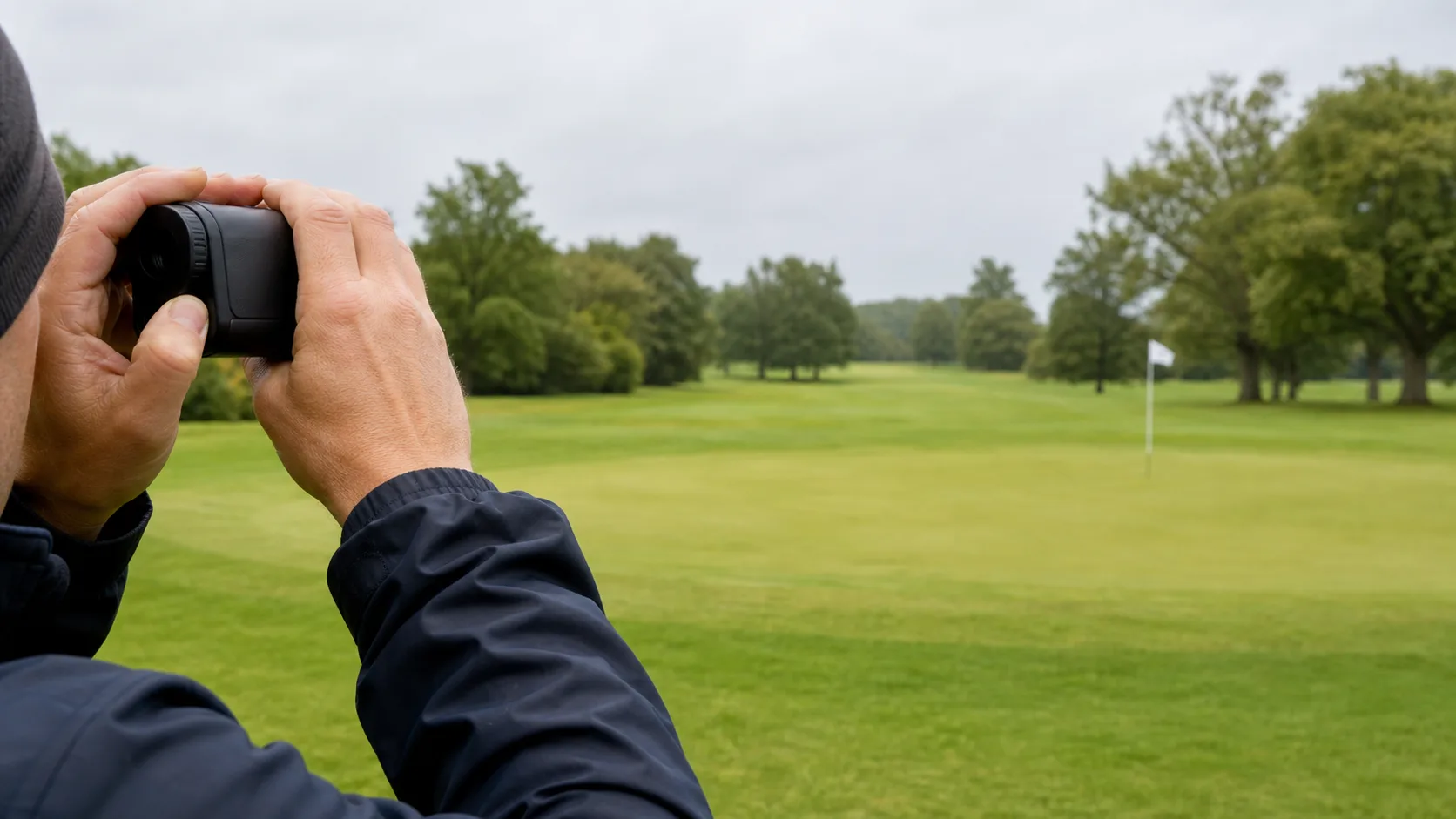
A laser rangefinder emits a beam towards the target and calculates distance from the reflected signal. You look through the eyepiece, aim at the flag or another object and press the button. Pin-lock and vibration features can help confirm that the device has picked up the flag rather than trees behind it.
It is direct, but it is only as useful as the target you select. The number to a flag is not automatically the number you should play. Wind, temperature, elevation and the place where you want the ball to finish still require judgement.
If the controls are unfamiliar, our explanation of slope, pin lock and jolt on a golf rangefinder covers what the display is telling you.
Which Gives Better Distance Information?
Laser: tighter targeting when the flag is visible
For a clear approach from the fairway, a good laser has the obvious advantage: it measures the actual flag rather than a mapped green point. That is useful for a player whose 7-iron and 8-iron carry windows make a flag-specific reading relevant.
It can also measure objects not stored in a GPS map. You might laser the lip of a fairway bunker, a tree at a dogleg or the group ahead before deciding whether it is safe to play. The strength is specificity.
The limitation is target acquisition. Small flags, shaky hands, rain, mist, reflective backgrounds and trees behind the green can make a reading slower or uncertain. Take a second reading if the first number looks implausible. The biggest practical laser error is not a faulty beam; it is locking onto the wrong object and trusting the result.
GPS: better context for club golfers
Front, middle and back distances encourage a sensible question: where is the useful landing area? If the middle is 145 metres but the back is 157 metres, you immediately know how much room exists beyond the centre. That is often more valuable than knowing the flag is precisely 148 metres away.
GPS data has its own tolerances. Your calculated position, the mapped course points and any course alterations can all affect the displayed distance. Treat a watch as decision support, not a survey instrument. We favour models with simple, sunlight-readable displays because a clear approximate picture beats a feature-rich screen that takes three taps to understand.
For improving golfers, front-middle-back numbers normally produce better decisions. They reduce the temptation to fire at every flag and work naturally with the broader strategy in our guide to practising golf effectively.
Which Is Faster and Easier During a Round?
The watch wins for pace
Raise your wrist, read the number, choose a club. That is the GPS-watch routine when the correct course and hole have loaded. It takes little time and does not require removing anything from a case or pocket.
This ease is especially useful for beginners, social fourballs and wet winter rounds. The device stays attached to you, so it is harder to leave in a buggy or beside a tee marker. Based on documented controls and display layouts, simple golf watches are easier to operate quickly than models overloaded with fitness and smart notifications.
There are annoyances. Some golfers dislike swinging while wearing a watch. Automatic hole changes can occasionally get ahead or lag behind when tees and greens sit close together. Touchscreens may be awkward with damp fingers or a glove. Physical buttons are not glamorous, but they work.
A laser asks more of the user
A laser is still quick once the habit is established: take it out, aim, confirm the target, put it away. A magnetic cart mount can reduce that friction, although it also creates an excellent way to donate a rangefinder to the next buggy user.
Steady aiming is the bigger issue. Players with hand tremor may find a watch far easier. Glasses are rarely a deal-breaker because many lasers have adjustable eyepieces, but it is worth trying one before buying. In persistent rain, wiping the lens and protecting the device adds another small interruption.
If keeping play moving is your priority, the watch wins. Good pace is part of basic golf etiquette for a first round, and distance technology should shorten decisions rather than create a committee meeting over every approach.
Course Mapping, Hazards and Blind Shots
GPS sees the mapped hole, not just what you can see
This is the decisive GPS advantage. On a dogleg, a watch can show distances to a mapped corner or hazard even when trees block the green. From a deep fairway bunker, it can still provide the front and back numbers. On an unfamiliar course, a hole map helps explain why the sensible tee shot is not always driver.
Hazard information varies by device. A basic watch may give one or two lay-up distances; a premium model may display a colour map and let you move the target. Check the feature list carefully. “Courses preloaded” does not guarantee the same mapping depth on every model.
Course data can also age. New bunkers, rebuilt greens and moved tees may take time to reach the provider’s database. Update the device before a golf trip and compare any suspicious number with course markers.
A laser needs something to aim at
A laser cannot measure through a hill, trees or thick fog. It can hit a visible marker post or tree near the intended line, but that is not the same as knowing the distance to a hidden green edge. This is why a laser feels brilliant on open parkland and less complete on a hilly or heavily wooded course.
The flip side is independence from mapping. If a bunker has been reshaped but its lip is visible, the laser measures the current object. It is also useful at the practice ground for checking target distances, provided the range layout gives a clear object to aim at.
Neither device chooses the shot. Use the information alongside your typical dispersion, lie and weather. A well-selected safe target will save more strokes than chasing a perfect number with the wrong club.
Battery, Cost and Ongoing Ownership
Purchase price
Entry golf watches and lasers commonly start around £100, while premium versions of either format can exceed £400. A laser’s price tends to rise with optics, target acquisition, stabilisation, build quality and slope features. A watch becomes dearer as mapping, display quality, sensors, statistics and smartwatch functions increase.
Do not compare only headline prices. A £150 golf-only watch may offer better course value than a £500 multisport model if you will never use its training features. Equally, a well-made mid-range laser can last for years without software becoming part of the buying decision.
Charging and batteries
Most GPS watches use rechargeable batteries. The official specification for the entry-level Garmin Approach S12, for example, states up to 30 hours in golf mode, though actual life depends on GPS use and conditions. That is enough for several ordinary rounds, but only if you remember to charge it.
Lasers often use a replaceable battery, with some newer models rechargeable by USB. They consume power only when taking readings, so battery anxiety is lower. Keep a spare compatible battery in the bag if your model allows it.
Apps and subscriptions
Core front-middle-back distances should not need a recurring fee, but some advanced maps, green contours or analytics may. Read the subscription terms rather than assuming every feature on the product page remains included. A watch may offer value away from golf through fitness tracking; a laser is a dedicated golf tool.
Our buying comparison is simple: pay for the information you will use every round. Extra dashboards do not compensate for a cluttered on-course experience.
Can You Use Both in Competitions?
Under the current Rules of Golf, distance-measuring devices are generally allowed. The governing bodies explain that Rule 4.3 permits measuring distance, while a committee may introduce a Local Rule prohibiting electronic distance-measuring devices. The USGA and R&A explanation of the rule change states this default clearly.
The important distinction is between distance and other conditions that affect play. A device may contain a slope function, but you must not use prohibited functions during a qualifying round. Turn tournament mode on and confirm that slope-adjusted information is disabled. The same principle applies whether the device is a laser, watch or phone.
Before a competition:
- Read the event Local Rules. Do not assume the club’s ordinary policy applies to a county or open event.
- Disable slope and prohibited assistance. Know how your device indicates legal mode.
- Check the battery and course. Charge a watch, fit a sound laser battery and update maps before leaving home.
- Ask the committee if unsure. A quick question is cheaper than a penalty.
Distance information is public information, but advice such as club selection remains a different matter. Use the number; make the golfing decision yourself.
Which One Should You Buy?
Buy a GPS watch if…
- You play unfamiliar courses. Hole shape, hazards and blind targets matter as much as the flag.
- You want fast decisions. A wrist glance is the least disruptive routine.
- You are building course management skills. Front-middle-back distances encourage safer targets.
- You struggle to hold a laser steady. No aiming is required.
For most golfers buying only one device, this is our recommendation. Start with a simple watch rather than paying for advanced analytics you may ignore.
Buy a laser rangefinder if…
- You know your carry distances. A precise target number can genuinely change the club choice.
- You prefer not to wear a watch. The laser stays in the bag until required.
- You practise to specific targets. A laser can verify visible flags and markers at the range.
- You value long-term simplicity. There are no course maps to download or update.
See our current golf rangefinder buying guide for the laser and GPS options that justify their price.
When using both makes sense
Low-handicap players and golfers travelling to unfamiliar courses can benefit from both: the watch supplies the hole picture, then the laser confirms the visible flag. That is a luxury, not a requirement. Using two devices for every shot can slow play and flood a simple decision with numbers.
The biggest buying mistake is choosing precision before deciding what information you need. If you regularly miss greens by 15 metres, an exact flag reading will not solve the real problem. Choose the watch for context and speed; choose the laser for visible-target precision. If still unsure, the GPS watch is the safer first purchase.
Frequently Asked Questions
Is a golf GPS watch more accurate than a laser rangefinder? Not for the same target. A laser can give a more exact reading to a visible flag, while a GPS watch estimates distances to mapped green points. The watch may still provide the more useful course-management information.
Do professional golfers use rangefinders? Rules vary by competition. Distance-measuring devices may be allowed under the Rules, but a committee can prohibit them through a Local Rule. Always check the event conditions.
Can a GPS watch measure the flag position? Most watches show mapped front, middle and back green distances rather than the day’s exact flag. Some systems offer enhanced pin-position features, but availability and setup vary.
Does a laser rangefinder work in fog or rain? Performance can become less reliable because moisture and poor visibility interfere with seeing and acquiring the target. A GPS watch is usually more practical when the flag is obscured.
Are slope rangefinders legal in competitions? The device may contain a slope function, but slope-adjusted information must not be used when the Rules prohibit it. Use the compliant tournament mode and check the Local Rules.
Is it worth carrying both a GPS watch and a laser? It can be for an experienced golfer who wants hole context plus an exact visible-target reading. Most club golfers can make good decisions with one device and will be better served by learning its limitations.