Learning how to fly with golf clubs from the UK is straightforward when you treat the bag as a separate travel job: confirm the operating airline’s rules, book the correct allowance, pack the clubs against impact and keep evidence of their condition. Do those four things before leaving home and most of the usual airport surprises disappear.
Airlines do not apply one universal rule to golf equipment. A golf bag may count within a checked allowance on one booking but require a separate sports-equipment fee on another. We checked the current published policies of British Airways and easyJet separately rather than assuming that “sports equipment” means the same thing everywhere.
This guide explains the complete process from a UK departure airport, including packing, weight, check-in, connections, collection and what to do if the bag is delayed or damaged.
In This Article
Check the Airline Policy Before You Book
Start with the airline that will actually operate the flight, not a general blog, an old forum answer or the logo shown most prominently by a booking website. Rules can differ by airline, route, fare and even the aircraft operator on a codeshare.
Look for answers to five questions:
- Is a golf bag included within your checked-baggage allowance or sold as separate sports equipment?
- What is the maximum weight for one golf bag?
- Is there a size or out-of-gauge rule?
- Must the equipment be added before online check-in or merely declared at the airport?
- What may be packed inside the golf cover?
The difference between two major UK airlines shows why this check matters. British Airways says golf equipment can travel as part of a checked-baggage allowance, provided it is suitably packed and within the relevant limits. If your fare has no checked bag, or you have already used the allowance, you need to pay for another checked item.
easyJet classifies golf clubs as small sports equipment, with a published maximum weight of 20kg. Its sports-equipment allowance is bought separately from ordinary hold luggage and the weight cannot be pooled between the two.
Those examples are useful, but they are not a substitute for checking your own booking. Airline policies and fees change. Save or screenshot the current rule after booking, especially if the wording confirms that golf equipment is included. If a travel agent or package organiser has added baggage for you, ask for the allowance in writing and check that it appears in the airline booking.
For the wider planning stage, our guide to booking a golf holiday as a package, DIY trip or group explains where flight-inclusive arrangements differ from building the trip yourself. If you are still choosing where to go, start with the best golf holidays from the UK rather than choosing a baggage solution before the destination.
Check the operating carrier on connecting flights
A ticket sold by one airline can contain a sector operated by another. Also check whether baggage is tagged through to the final destination or must be collected and checked in again during the connection. The strictest applicable limit is the safest one to pack to unless the airline confirms otherwise.
If separate tickets are involved, assume you will need enough connection time to collect the golf bag, clear any required formalities and repeat the check-in process. A missed second flight caused by an optimistic self-transfer can be much more expensive than a longer connection.
Choose and Prepare a Protective Travel Cover
Use a purpose-made golf travel cover that closes securely and can survive conveyor belts, trolleys and stacking. Your everyday stand or cart bag is not enough protection on its own, and exposed club heads should never be handed over as ordinary baggage.
There are two broad types:
- Soft travel covers are lighter, easier to store and often simpler to fit into a hire car. They depend on padding and careful internal packing for protection.
- Hard cases provide a rigid shell and stronger crush protection, but they are heavier, bulkier and may consume more of the allowance before the clubs go inside.
Neither format makes careless packing harmless. A soft cover can travel safely when the vulnerable top section is supported and padded. A hard case can still allow clubs to move and strike each other if the contents are loose.
Before using the cover, inspect its zip, stitching, handles, wheels, buckles and seams. Remove old baggage labels and make sure your contact details are visible without placing your home address on public display. Put a second contact card inside in case the external tag disappears.
Your normal golf bag should also be suitable for the trip. A lighter stand bag leaves more allowance for shoes and protective material, while a larger cart or tour-style bag may be more convenient at the course but less forgiving at the airport. Our guide to stand, cart and tour golf bags explains the practical differences.
Soft cover or hard case?
Choose according to the whole trip rather than assuming one is always best. A rigid case makes sense when maximum crush protection is the priority and your onward transport has room for it. A well-padded soft cover can be the more manageable choice for train connections, small hire cars and limited storage.
Whichever you use, check its empty weight on reliable scales. A heavy shell may force you to remove shoes, clothing or accessories to remain within the airline limit.
How to Pack Golf Clubs for a Flight
Our packing advice prioritises the most plausible handling damage: bent shafts, snapped or marked club heads, torn covers and loose contents striking the equipment. The goal is to stop the longest clubs taking a direct load and prevent everything inside from moving freely.
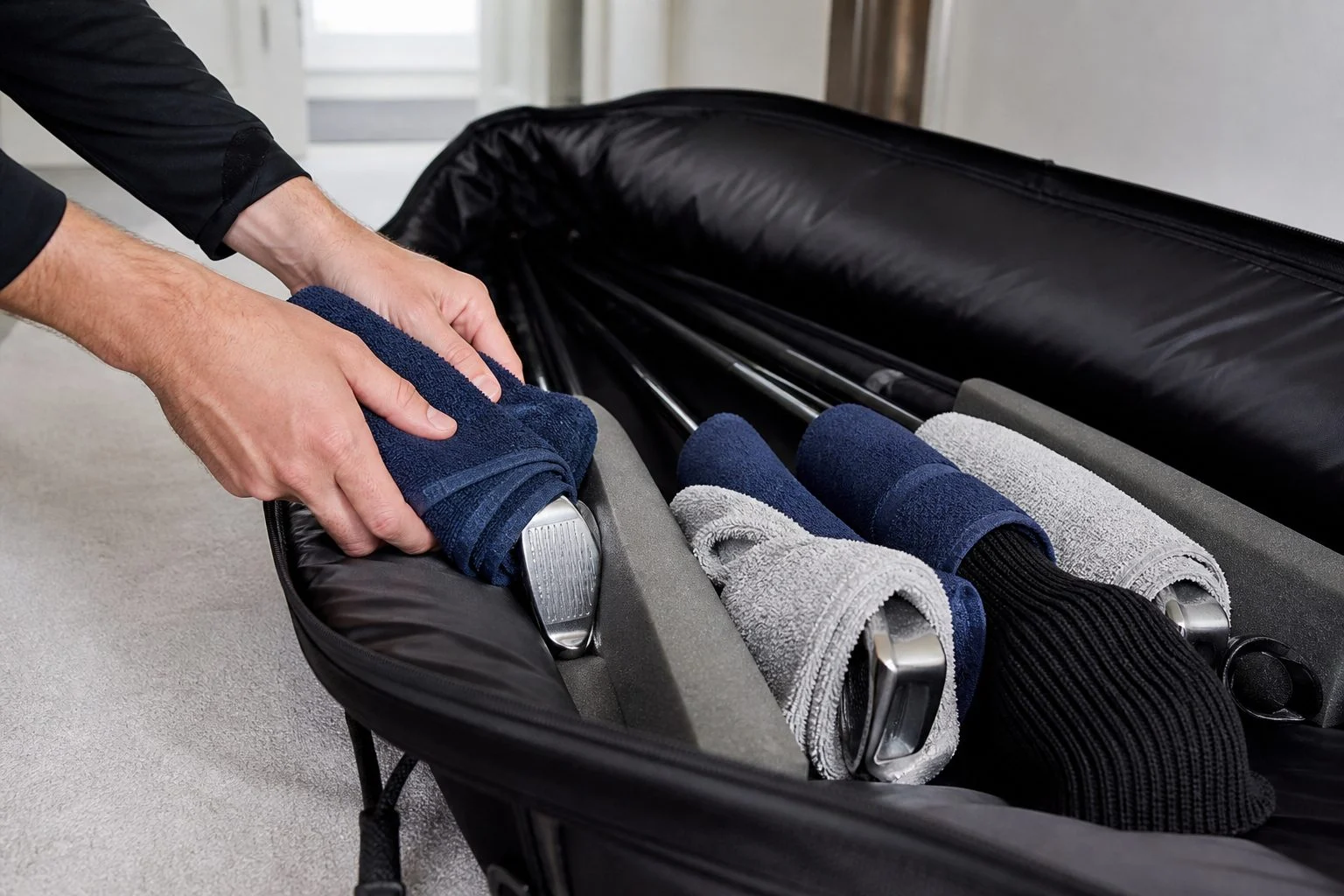
Pack in this order:
- Empty and inspect the golf bag. Remove rubbish, liquids and anything prohibited or unnecessary. Check pockets you rarely open.
- Photograph the clubs and bag. Capture the club heads, shafts, golf bag and empty travel cover in good light before packing.
- Remove adjustable heads where practical. Put the head in a padded cover and store it securely inside the bag. Refit the shaft adaptor cover if you have one.
- Protect the longest remaining clubs. Use a rigid support pole designed for a travel cover, set slightly longer than the longest club. It should take a top-down impact before a shaft does.
- Group and pad the club heads. Use headcovers, towels or clothing to stop metal heads knocking together. Do not leave the putter or wedges loose.
- Secure the golf bag inside the cover. Tighten internal straps and fill large voids with soft, lightweight items so the bag cannot slide around.
- Close every pocket and strap. Tuck away loose webbing where possible. External straps should be secure but not crushing the bag.
- Weigh the finished travel cover. The number that matters is the complete packed weight, not the weight of the clubs alone.
Keep the club-head removal tool in the golf bag, but avoid creating a dense pouch of loose metal objects. Small accessories should be contained. The golf accessories checklist can help you decide what is essential, but flying is a good reason to leave duplicate gadgets at home.
What can go inside the golf bag?
Only pack items permitted by the operating airline and relevant security rules. Clubs, shoes, balls, tees and an umbrella are commonly associated with golf equipment, but an airline may define the accepted contents more narrowly or count a separate umbrella as another item.
Do not assume that spare batteries, aerosols, flammable products or electronic devices can be placed in the hold simply because they fit. Check the airline’s dangerous-goods guidance. Battery rules are particularly important if you use a GPS device, rangefinder or powered trolley accessories.
Avoid packing passports, medication, keys, irreplaceable valuables or the clothes you need immediately on arrival. Keep those in your permitted cabin baggage. A delayed golf bag is inconvenient; it should not also leave you without essential documents.
Should you use a tracking device?
A compatible luggage tracker may help you see whether a bag reached an airport, but it does not replace an airline tracing report and it cannot compel ground staff to retrieve baggage. Check that the device and battery comply with the airline’s current rules, place it where it will not damage the clubs and keep its details private.
Weight Limits, Dimensions and Baggage Fees
Weigh the packed cover at home using luggage scales, then repeat the check after adding last-minute shoes or clothing. Leave a sensible margin rather than aiming for the exact maximum: domestic scales can differ from airport equipment, and damp towels or extra purchases add weight on the return flight.
Three separate concepts cause most confusion:
- Checked-baggage allowance: the number and weight of bags included in your fare or status.
- Sports-equipment booking: a separate paid or reserved category used by some airlines.
- Oversize or out-of-gauge handling: the airport process for an item too long or awkward for the ordinary belt, even when it is within the airline allowance.
An item can be included in your allowance and still need to go to the oversize-baggage point. “Oversize” does not automatically mean “overweight”, and neither word tells you whether the fee is included.
When comparing fares, calculate the complete return cost. A headline-cheap flight can become less competitive after adding sports equipment in both directions, seat selection and a second bag for ordinary clothes. Conversely, a fare with checked baggage included may cover the golf bag but leave no separate allowance for a suitcase.
Add golf equipment online or in the airline app whenever the policy allows. Airport charges are often higher, and some services have limited capacity for sports equipment. Keep the confirmation with the booking and check that both outbound and return sectors show the allowance.
Do not rely on pooled weight
Some airlines let passengers on the same booking share ordinary hold allowance, while others apply limits per item. Sports equipment may have separate rules again. easyJet, for example, states that sports-equipment and hold-luggage weight cannot be combined to create a larger allowance for one bag.
If two golfers share one travel cover, confirm that the airline permits this and that the complete item remains within its single-piece limit. One very heavy cover is harder to handle and may trigger an overweight restriction even when two allowances were purchased.
How to Fly with Golf Clubs Through a UK Airport
Allow more time than you would with cabin baggage alone. Golf covers often use a separate out-of-gauge belt, and the handover point may be away from the main check-in desk. Follow the live instructions from your airline and departure airport rather than relying on a fixed timing quoted by someone else.
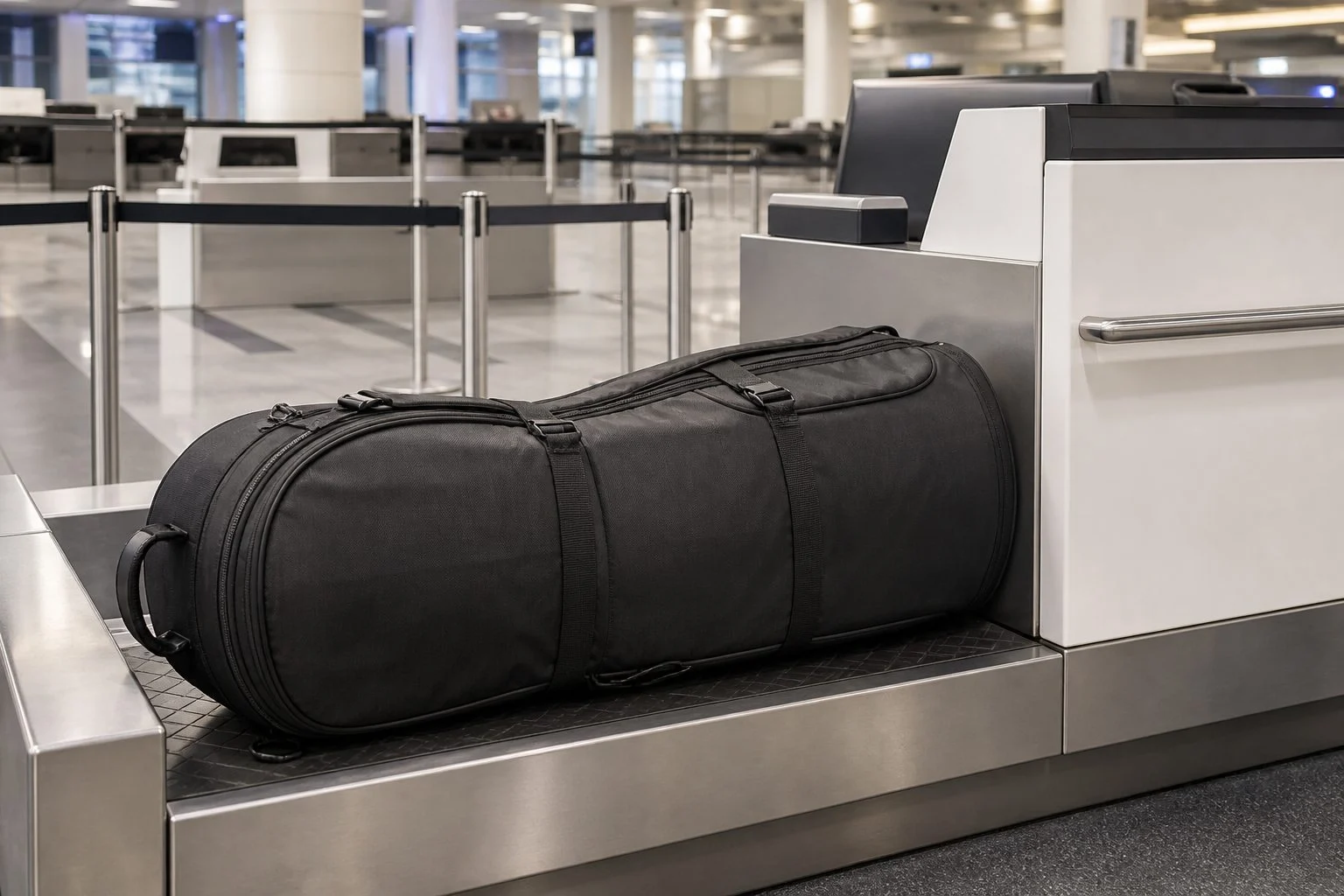
The usual sequence is:
- Complete online check-in if available and confirm the golf equipment appears on the booking.
- Take the packed cover to the airline bag-drop or staffed check-in desk.
- Show the sports-equipment booking or checked-baggage allowance if requested.
- Keep the baggage receipt after the tag is attached.
- Take the cover to the designated oversize or out-of-gauge handover point if directed.
- Watch until staff accept the item; do not leave it beside a closed belt or unattended counter.
Before handover, take one final photograph showing the cover closed and its exterior condition. Do not photograph sensitive travel documents or other passengers. Keep the baggage-tag receipt somewhere separate from the golf bag.
During connections
At the first check-in desk, ask whether the golf bag is tagged to the final airport. Read the printed destination code on the baggage receipt. If you must collect it during the connection, find out whether collection is on the standard carousel or an oversize-baggage point.
For a self-transfer on separate tickets, plan around baggage reclaim and a fresh check-in deadline. You may also need to move between terminals. The airline operating the second flight is unlikely to protect a separate booking if the first flight or baggage delivery is late.
Collecting clubs on arrival
Golf bags may appear on the normal carousel, at an oversize belt or at a staffed collection point. Check the airport screens and listen to announcements, but ask ground staff if ordinary baggage has finished and the golf cover has not appeared.
Inspect the cover before leaving the baggage area. Look at the wheels, handles, seams and zip, then feel for an obvious break or severe bend around the club heads. If damage is visible, photograph it in place and report it immediately.
If you are planning a domestic trip rather than flying abroad, our guide to the best golf breaks in Scotland, Wales and England may help you decide whether rail or car travel is simpler than taking clubs through an airport.
What to Do If Your Clubs Are Delayed or Damaged
Report a missing or damaged golf bag before leaving the airport whenever a baggage desk is available. Ask for a reference number—often called a property irregularity report or PIR—and record the name of the handling airline or agent.
We recommend photographing the packed equipment before departure and the closed cover at handover because this creates a timestamped record of what travelled and its apparent condition. It does not guarantee that a claim will succeed, but it is more useful than trying to reconstruct the evidence after a problem.
For delayed baggage:
- keep the baggage receipt, boarding pass, booking confirmation and report reference;
- provide a reliable delivery address and contact number;
- ask how to track the report and how updates will be sent;
- keep itemised receipts for necessary replacement or hire costs;
- check the airline and insurer’s rules before making expensive purchases.
For visible damage:
- photograph the exterior before moving or opening the cover;
- record damage to the travel cover, golf bag and individual clubs;
- keep broken parts and packaging unless told otherwise;
- report the issue through the airline’s required channel within its stated deadline;
- contact your travel insurer if the loss may fall under the policy.
Do not promise yourself that an airline, card provider or travel insurer will pay for every damaged club. Cover, exclusions, depreciation, excesses and reporting deadlines vary. Read the policy before travel and check whether sports equipment has a single-item limit below the replacement cost of your set.
If the clubs arrive after your tee time
Contact the course, resort or package organiser as soon as the delay threatens a booking. Some venues can arrange hire clubs, but availability and suitability are not guaranteed. Keep communication and receipts without assuming that every green fee, hire charge or missed round will be reimbursed.
If the trip revolves around a particular course, build some resilience into the schedule. Arriving the day before the first important round gives delayed baggage more time to catch up than landing a few hours before the tee time.
Golf-Club Flight Checklist
Use this short list after completing the detailed steps above.
Before leaving home
- Check the operating airline’s current golf-equipment rule for every sector.
- Confirm the allowance is visible on the booking.
- Inspect the travel cover, wheels, zip and handles.
- Remove adjustable club heads where appropriate and protect the longest shafts.
- Pad the club-head area and secure the bag inside the cover.
- Remove prohibited, valuable and essential personal items.
- Photograph the clubs, golf bag and closed travel cover.
- Weigh the finished item with a margin below the maximum.
- Put contact details inside and outside the cover.
At the airport
- Arrive with extra time for staffed or oversize-baggage handling.
- Keep proof of the booked sports equipment or checked allowance.
- Retain the baggage-tag receipt.
- Follow the bag to the designated handover point when instructed.
- Confirm the final destination on the tag for a connecting itinerary.
On arrival
- Check both the ordinary carousel and oversize collection area.
- Inspect the cover and clubs before leaving baggage reclaim.
- Report delay or damage immediately and obtain a reference.
- Keep photographs, booking documents and itemised receipts.
The Bottom Line
The safest way to fly with golf clubs from the UK is to verify the exact airline rule before booking, reserve the right baggage allowance, protect the longest clubs and keep the packed cover comfortably within the limit. At the airport, retain the baggage receipt and inspect the equipment before leaving arrivals.
The biggest mistake is assuming that every airline treats a golf bag as an ordinary checked suitcase. The second is relying on a padded cover without stopping the clubs moving inside it. Control those two risks and the process becomes far more predictable.
Frequently Asked Questions
Can I take golf clubs on a plane from the UK?
Yes, most airlines accept golf clubs in the hold when they are packed in a suitable travel cover. The booking method, fee, weight limit and permitted contents vary, so check the operating airline’s current policy for every flight.
Do golf clubs count as normal checked baggage?
Sometimes. British Airways says suitably packed golf equipment can count within the checked-baggage allowance, while easyJet sells golf clubs as small sports equipment. Your fare and route still matter, so confirm the rule shown on your booking.
How should I protect golf clubs for a flight?
Use a secure travel cover, support the top of the bag with a rigid extension pole, remove adjustable heads where practical, pad the remaining club heads and strap the golf bag so it cannot move inside the cover.
Can I put clothes and golf shoes in my travel cover?
Only if the airline permits those contents and the complete bag remains within its limits. Soft clothing can provide useful padding, but keep essential items, valuables and anything restricted in the appropriate cabin or checked baggage.
Where do I collect golf clubs at the destination airport?
They may arrive on the ordinary carousel, an oversize-baggage belt or at a staffed collection point. Check the airport information and ask ground staff if the normal baggage delivery finishes without your golf cover.
What should I do if an airline damages my golf clubs?
Photograph the damage and report it before leaving the airport when possible. Obtain a report reference, retain the baggage receipt and booking documents, keep damaged parts, and follow the airline and insurer’s claim procedures within their deadlines.