The best golf travel bags UK golfers can buy protect the vulnerable top of a set without swallowing so much of the airline allowance that shoes and waterproofs have to stay behind. For most travellers, the MacGregor VIP II Premium is the best overall choice: it combines a padded top, internal restraint and three external straps at a sensible price. If you want rigid protection and can spend more, the BagBoy T-10 is the smarter buy.
In This Article
- Best Golf Travel Bags UK: The Quick Picks
- How We Chose These Golf Travel Bags
- The Best Golf Travel Bags Reviewed
- Soft vs Hard Golf Travel Covers
- What to Look for in a Golf Travel Bag
- How to Pack Golf Clubs in a Travel Bag
- Golf Travel Bag Mistakes to Avoid
- The Bottom Line
- Frequently Asked Questions
Best Golf Travel Bags UK: The Quick Picks
These five covers occupy meaningfully different positions. We have not padded the list with colour variations or near-identical soft bags.
| Travel bag | Best for | Typical UK price | Key trade-off |
|---|---|---|---|
| MacGregor VIP II Premium | Best overall | £55–£70 | Strong value, but no rigid shell |
| BagBoy T-10 | Best hard-top value | £149–£180 | Rigid top with a flexible body rather than a full hard case |
| CaddyDaddy Constrictor 2 | Best for frequent flyers | About £120 | Well padded and spacious, but still soft-sided |
| BagBoy T-660 | Best budget soft cover | About £100 | Less structure around the club heads |
| Longridge Hard Case | Best full hard case | About £175 | Strong protection, awkward to store |
Our shortlist is based on current UK availability, published construction details, empty weight, wheel design, storage and the way each cover controls movement around the club heads. We have not claimed hands-on testing that did not happen. Where a manufacturer supplies exact measurements, we use them; where retailers disagree or omit a figure, we say so rather than inventing precision.
The MacGregor VIP II Premium wins because it covers the essentials without pushing into premium-case pricing. Extra padding protects the club-head area, an internal strap limits movement and three external straps provide useful backup around the zipped body.
If a completely soft cover feels too exposed, the BagBoy T-10 is the hybrid sweet spot. Its ABS hard top shields the shafts and club heads, while the flexible lower body is easier to live with than a full-length moulded case.
How We Chose These Golf Travel Bags
A travel cover is not an ordinary golf bag with more fabric. Your stand or cart bag sits inside it, and the outer cover must absorb knocks, roll through a terminal and survive repeated lifting by handles and straps.
Protection came first
We looked for a rigid shell, reinforced top, dense padding or a combination of those features. The top 30–40cm matters most because driver and fairway-wood shafts can act as levers when the cover is dropped or compressed. Internal straps also count: a well-padded shell cannot help much if the golf bag repeatedly slides into it.
This selection method favours products whose protective features are described clearly, not those making the loudest claim. MacGregor specifies extra top padding plus internal and external restraint on the VIP II Premium; BagBoy specifies an ABS top and internal compression strap on the T-10. Those details provide a firmer basis than anonymous marketplace reviews.
Weight and movement matter together
The lightest cover is not automatically the easiest to travel with. A 3kg bag that drags on two poor wheels can be more tiring than a 5kg model supported by a stable leg-and-wheel system. Equally, a premium mechanism still counts against your checked allowance.
Ryanair currently treats golf clubs as large sports equipment for the hold and states a 20kg limit for that item. See its current sports-equipment guidance before flying. Other airlines set different rules, so the sensible calculation is total packed weight, not the cover’s empty figure alone.
Storage separated the practical options
Full hard cases are protective but bulky. If you live in a flat, drive a small hatchback or need to store four family cases, a folding soft cover has a real advantage. We gave credit for designs that collapse without leaving the wheels and base sticking out at an awkward angle.
Our final checks considered:
- Verified UK availability: a reader should be able to find the exact model from a UK retailer now.
- Useful handles: lifting points should be placed for a horizontal bag, not merely for standing it upright.
- Wheel protection: exposed, flimsy wheels are a common early failure point.
- Capacity: the case must accept the stated stand or cart bag without relying on excessive empty space.
- Honest value: extra cost needs to buy protection or easier handling, not just a tour-style badge.
The Best Golf Travel Bags Reviewed
MacGregor VIP II Premium — best overall
The VIP II Premium is the one we would buy for most golf holidays. Its tough nylon body has extra padding around the club heads, while an internal anti-burst strap and three heavy-duty external straps help keep the load controlled. It accepts drivers up to 49 inches and rolls on two inline skate wheels.
The compromise is that this remains a soft cover. It is easier to fold and store than a moulded case, but careful packing and a support rod are still sensible if your driver head cannot be removed.
It commonly sits around £55–£70 in the UK, which makes the protection unusually convincing for the money. The large external pocket is useful for shoes or waterproofs, although those extras still count towards the airline weight allowance.
- Pros: padded club-head area; internal restraint; three external straps; strong value; folds for storage.
- Cons: no rigid shell; only two wheels; careful packing remains important.
BagBoy T-10 — best hard-top value
The BagBoy T-10 combines an ABS hard top with a 600D polyester body. This hybrid construction puts rigid material where clubs are most exposed while allowing the lower section to fold more easily than a complete hard case.
An internal compression strap controls the golf bag, and an external anti-burst strap backs up the zip. BagBoy states that it accommodates a driver up to 48 inches and a cart bag up to 10 inches wide. Two external shoe or clothing pockets make better use of the space than one huge compartment where everything can migrate towards the club heads.
UK prices have recently sat around £149 at specialist golf retailers, although American Golf has also listed it at £180. At the lower price, this is the strongest value in the shortlist.
- Pros: rigid ABS top; internal and external restraint; useful external pockets; easier storage than a full hard case.
- Cons: the lower body is still soft; inline wheels are less nimble than swivelling casters; exact fit needs checking for oversized tour bags.
CaddyDaddy Constrictor 2 — best for frequent flyers
The Constrictor 2 is a practical step up for golfers who fly regularly but do not want the price or storage burden of a moulded case. Dense padding surrounds the club-head area, while internal and external compression straps help stop the golf bag shifting inside.
Lockable zips, large side pockets and replaceable-style rolling wheels make it better suited to repeated journeys than a basic cover. CaddyDaddy also advertises one-year replacement coverage for its travel bags, although UK buyers should confirm the applicable seller terms when ordering.
At about £120 on Amazon UK, it costs more than an entry-level soft cover but remains far below many premium four-wheel designs. Its conventional two-wheel layout still needs tilting and pulling, so frequent travellers prioritising effortless terminal movement may prefer a dearer specialist system.
- Pros: dense top padding; internal and external restraint; large side pockets; lockable zips; one-year replacement coverage advertised.
- Cons: still soft-sided; conventional two-wheel handling; bulkier than a basic cover when folded.
BagBoy T-660 — best budget soft cover
At about £100, the T-660 is a sensible entry point if you want a recognised travel-cover design without spending close to the cost of a new wedge. It is a conventional wheeled soft cover, so it folds down and takes less room in a car or cupboard.
The compromise is predictable: there is no rigid top. Careful packing and a support rod become more important, particularly if your driver head cannot be removed. This is the model for a golfer taking an occasional short-haul trip with a lightweight stand bag, not someone checking an expensive set every month.
- Pros: accessible price; lighter and simpler than premium rolling systems; compact storage.
- Cons: needs more deliberate club-head padding; offers less crush protection; basic wheels put more load on your arm.
Longridge Hard Case — best full hard case
The Longridge case is the blunt solution: a moulded outer shell protects along the full length rather than only at the top. Retail prices are about £175, which is competitive for a rigid case.
It suits golfers whose priority is impact resistance and who have garage or loft space at home. It is also worth considering when a soft cover would spend the trip beneath other heavy luggage. The downside appears at both ends of the journey. A full case is awkward in smaller hire cars, cannot be folded in a hotel room and may be heavier before you pack a single club.
- Pros: full-length rigid protection; wipes clean; fewer fabric panels to snag or tear.
- Cons: bulky storage; awkward in compact cars; fit and latch condition need careful checking before every trip.
Soft vs Hard Golf Travel Covers
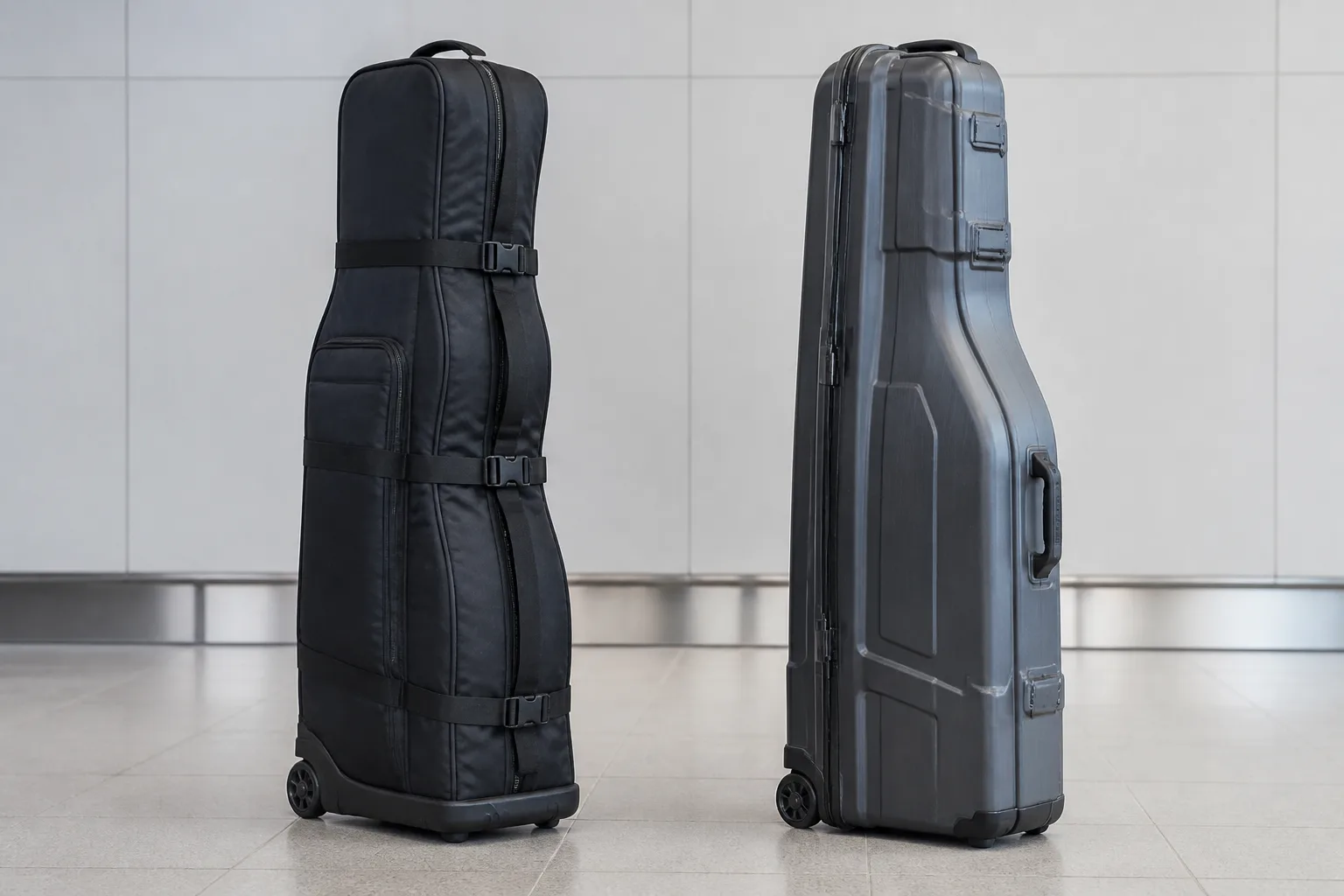
Soft covers are the right default for most UK golf holidays. They are easier to lift, fit into more boots and fold away at the destination. Good models reinforce the club-head area and use internal straps to stop the contained bag sliding.
Hard cases make sense when protection outranks convenience. A rigid shell spreads an impact across a larger area and resists crushing better than fabric. It does not make your clubs indestructible: a poorly restrained bag can still move inside, and latches or hinges can be damaged.
The hybrid option is often the best compromise
The BagBoy T-10 illustrates why a hard-top hybrid is appealing. The vulnerable shafts and heads sit beneath rigid ABS, while the flexible body keeps storage manageable. For many golfers, that is a more balanced design than either a thin soft cover or a full moulded case.
Choose a soft cover if:
- Storage is tight at home or in the hotel.
- You travel with a lighter stand bag and can remove your driver head.
- You value easier lifting and accept the need for careful internal padding.
Choose a hard case if:
- Your clubs travel frequently or face multiple flight connections.
- You cannot remove the longest club heads and want more crush resistance.
- You have room to store and transport the empty shell.
Our broader guide to flying with golf clubs from the UK covers airline booking, check-in and damage steps. The buying decision here is simpler: soft for convenience, hard for maximum protection, hybrid for the best compromise.
What to Look for in a Golf Travel Bag
Measure your bag and longest club
Do not assume “fits most cart bags” includes an oversized tour bag. Measure the widest part of your current bag and the total height with the longest club installed. Allow room for padding without buying a cavernous cover that lets the load build momentum.
If you are still deciding what goes inside, our guide to the best golf bags in the UK explains why a lighter stand bag is usually the easier flight companion.
Check the empty weight against your airline
Weigh the cover, golf bag and normal contents together. Do not rely on adding catalogue figures because shoes, balls, waterproofs, towels and a rangefinder quickly add several kilograms. The International Air Transport Association advises passengers to place identification both outside and inside checked baggage; its passenger baggage guidance is a useful general checklist, but your airline’s conditions control the actual allowance.
Inspect the top, wheels and handles
The top should have dense padding, a rigid panel or both. Press it with your hand: a decorative quilted panel that collapses instantly is not the same as a protective structure.
Wheels should sit within a reinforced base and turn without wobbling. Also imagine lifting the bag from a baggage belt. A top grab handle alone is not enough; side or base handles let two people share a heavy horizontal load.
Look for restraint, not just space
At least one internal strap should hold the contained golf bag against the cover. External compression straps reduce strain on the zip and limit bulging. Lockable zip pulls are useful for keeping the closure together, but a small luggage lock is not a defence against crushing or determined theft.
You still need to organise the contents sensibly. Our golf accessories checklist helps separate useful travel kit from the objects that merely add weight.
How to Pack Golf Clubs in a Travel Bag
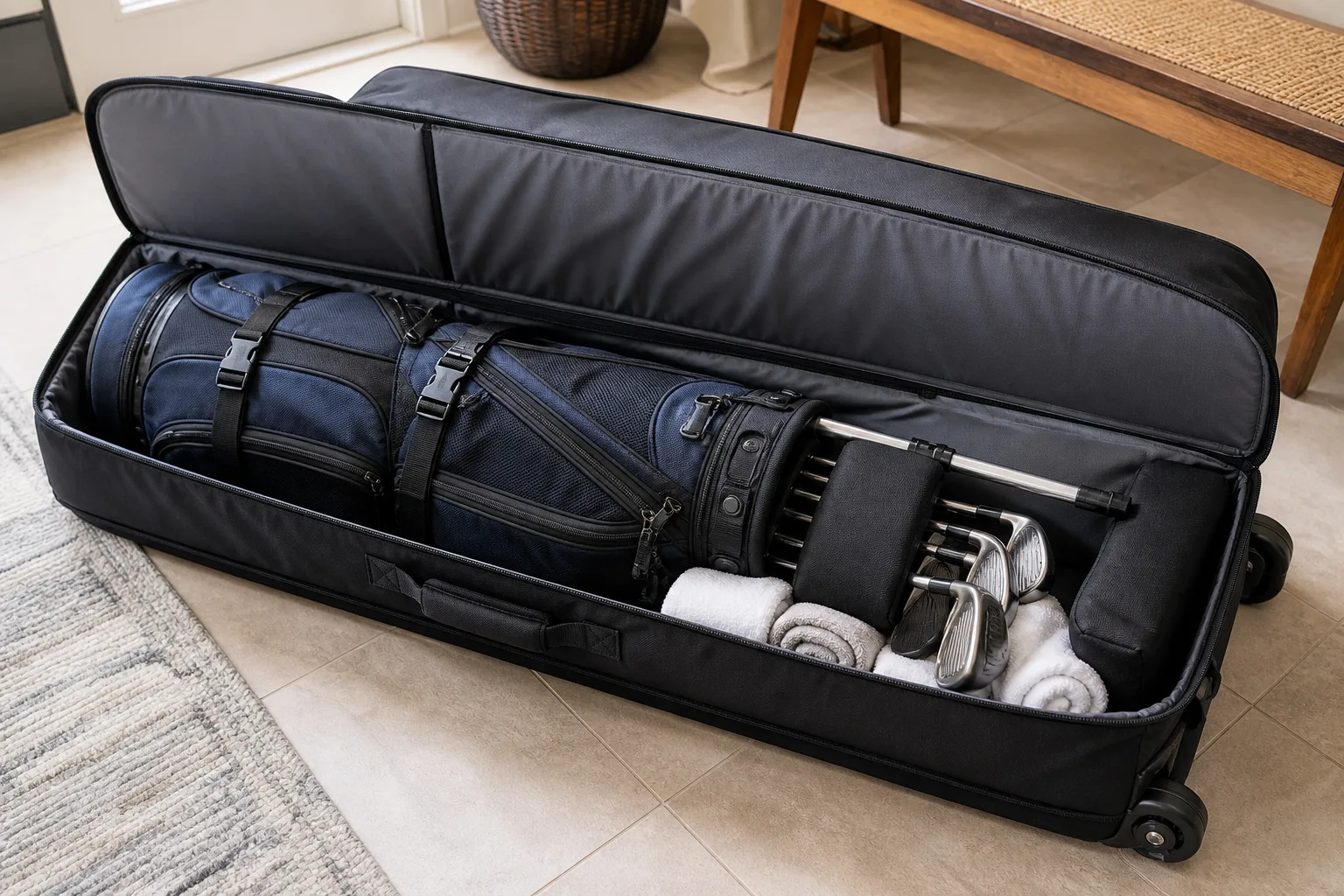
The cover can only protect equipment that has been packed to prevent movement. A premium bag with loose irons rattling against a driver shaft is an expensive way to do a basic job badly.
- Remove detachable club heads. Take off driver and fairway-wood heads where the design allows it, return each screw lightly to the shaft adaptor and pack the heads in padded headcovers. Note the settings first.
- Turn remaining clubs upside down where practical. Grips at the top reduce the number of exposed club heads. Keep putters or fixed-head woods central rather than pressed against the outer wall.
- Add a support rod. Set a telescopic travel protector slightly longer than the longest remaining club so an impact reaches the rod before the shaft.
- Bind the clubs together lightly. Use a towel around the heads and a soft strap around the bundle. Do not cinch graphite shafts against one another with a hard cable tie.
- Secure the golf bag inside the cover. Tighten internal straps, then fill small gaps with soft clothing. Avoid placing heavy shoes directly beside club heads.
- Weigh and identify the finished bag. Put contact details inside as well as on the outer tag, photograph the packed contents and keep the baggage receipt.
If you need a full airport sequence, use our guide on how to book and prepare for a golf holiday. Packing is only one part of avoiding an unpleasant conversation at check-in.
Golf Travel Bag Mistakes to Avoid
Buying the largest cover “to be safe”
Extra space does not equal extra protection. It increases packed volume, encourages overpacking and allows the inner bag to move. Buy for the bag you own, with enough room for padding rather than a second wardrobe.
Ignoring the weight of the cover
The difference between a 3kg and 5.5kg cover matters under a 20kg sports allowance. A feature is not free if it forces shoes and clothing into another paid bag.
Trusting the zip to restrain everything
Use the internal and external straps. A zip closes the cover; it should not carry every force created by loose contents. Check stitching around the handles too, because baggage staff will lift from whichever handle is easiest to reach.
Packing prohibited or poorly protected items
Check the airline’s current rules for batteries, aerosols and sharp tools. Remove loose valuables and electronics. Golf balls are dense, so spread a small number through secure pockets rather than placing several boxes next to a fragile shaft.
Skipping the arrival check
Inspect the cover before leaving baggage reclaim. Photograph torn fabric, broken wheels, split latches or crushed areas while the bag is still at the airport. Our golf holiday guide can help with destination planning; it cannot recover evidence you forgot to collect.
The Bottom Line
The MacGregor VIP II Premium is the best golf travel bag for most UK travellers. It provides useful club-head padding and multiple restraint straps, folds for storage and costs far less than most premium travel systems.
Buy the BagBoy T-10 if you want the strongest balance of price, protection and storage. The rigid top deals with the vulnerable end of the set without giving you a full hard case to hide in the hotel room.
Choose the CaddyDaddy Constrictor 2 when regular flights justify denser padding, stronger restraint and more storage than a basic soft cover. Choose the BagBoy T-660 for occasional budget trips, provided you add a support rod and pack carefully. The Longridge Hard Case is the specialist choice when rigid protection matters more than storage.
Whichever model you choose, fit is more important than a long feature list. A correctly sized, restrained and weighed travel bag will do more for your clubs than an oversized premium cover packed in a rush.
Frequently Asked Questions
Do airlines require a golf travel bag? Airlines normally require golf clubs to be checked as sports equipment, but the exact packaging rule varies. A purpose-made travel cover is the practical way to protect the set and contain loose parts. Check the operating airline’s current policy before travel.
Is a hard or soft golf travel case better? A hard case offers more crush and impact resistance. A padded soft cover is easier to store, lift and fit into a car. A hard-top hybrid is the best compromise for many occasional travellers.
Can I put clothes and shoes in my golf travel bag? Usually, subject to the airline’s allowance and prohibited-item rules. Use soft clothing to fill small gaps, but do not overpack or place heavy shoes beside club heads. Weigh the entire bag at home.
Should I remove my driver head before flying? Yes, if the head is designed to be removed. Record the hosel setting, refit the screw lightly to the adaptor and protect the head separately. Never force a fixed-head club apart.
How much should a golf travel bag weigh? Soft covers often weigh roughly 3–5.5kg, while full hard cases may be heavier. The right figure depends on your airline allowance and the weight of the bag and clubs inside, so calculate the complete packed load.
Is a golf travel bag worth buying for one trip? It can be, particularly if you own clubs worth far more than the cover. For one annual direct flight, a well-padded £100 soft cover may be enough; frequent travellers gain more from rigid protection and better wheels.