The best golf practice nets are the ones you will actually use three times a week, not the biggest cage you can squeeze into the garden. For most UK golfers, that means a stable net, a proper hitting mat, enough side protection for the occasional heel strike, and a setup that packs away before the rain ruins it. If you are searching for the best golf practice nets UK golfers can use at home, start with space and safety before brand names.
In This Article
- Best Overall Golf Practice Net for Most UK Golfers
- What Actually Matters Before You Buy
- Best Golf Practice Nets 2026
- Pop-Up vs Framed vs Cage Nets
- Mats, Balls and Home Safety Extras
- Practice Drills That Make a Net Worth Owning
- Bottom Line
- Frequently Asked Questions
Best Overall Golf Practice Net for Most UK Golfers
If I were buying one home net in 2026, I would buy the Spornia SPG-7 standard net at about £300-£350, or the SPG-7 bundle at roughly £399 when it includes a better mat. It is not the cheapest option, but it solves the three problems that make budget nets annoying: slow setup, weak impact control, and balls rebounding around your garage.
The cheaper Decathlon Inesis golf practice net at £59.99 is still the best budget buy if you only want occasional garden swings. It is light, easy to store, and good enough for wedges and controlled iron shots. I would not choose it as a daily driver net unless you are happy to replace it sooner and keep driver speed out of the equation.
The premium pick is The Net Return Pro, usually around £828-£995 through UK and European golf-simulator suppliers depending on bundle and side barriers. That is serious money, but the frame quality, ball return and multi-sport durability make sense if you are building a garage practice bay or using a launch monitor.
For most golfers, the sweet spot is not the huge simulator enclosure. It is a mid-range net with a mat you trust and enough safety space behind and beside it. Spend £300 on the net and £80-£200 on the mat before you spend £500 on a launch monitor. A cheap mat with a good net still leaves you practising from a surface that punishes your wrists and gives false turf interaction.
What Actually Matters Before You Buy
A golf practice net looks like a simple product until you start hitting proper balls into it. Then the details matter very quickly.
Size and miss protection
The headline width is not the same as safe hitting width. A 2.1m net can catch centred shots all day and still feel tiny if your strike pattern includes shanks, toe hooks or high wedge shots. For a driver, I want at least 2.1m width and 2.1m height, plus side netting if the net is indoors or near fences, windows, cars or neighbouring gardens.
If your practice is mostly wedge and short iron work, a smaller pop-up net can work. If you plan to hit driver, buy bigger than you think. Read the manufacturer dimensions carefully and check whether they quote frame width or the actual catch area. The Net Return Pro Series V2 specs are a useful benchmark because they publish width, height, depth and ball-speed claims clearly.
Frame stability
Wind is the UK garden problem nobody mentions in glossy product photos. A featherweight net that behaves nicely in a warehouse can turn into a sail on a breezy patio. Pegs help on grass, but they do nothing on decking or concrete.
For outdoor use, look for:
- Wide feet: a deeper base is harder to tip than a narrow upright frame.
- Ground pegs: useful on grass, especially for pop-up nets.
- Replaceable netting: better than binning the whole frame when the impact panel wears.
- Quick pack-away: if it takes 20 minutes, you will leave it out in drizzle and shorten its life.
I have seen cheaper garden nets sag after a few wet weeks. They are fine if you treat them as occasional kit, dry them before storage, and accept the trade-off. They are poor value if you expect permanent outdoor durability.
Real balls or foam balls
Many nets claim they can handle real golf balls. That does not mean your space can. The net might survive impact, but a miss over the top, a ricochet off a garage wall, or a ball sneaking under a loose lower edge can still cause damage.
Foam balls are safer for warm-ups, movement drills and winter practice in tight spaces. Real balls make sense only when the net is large enough, the ground is level, the lower edge is secured, and you have checked the first dozen shots at half speed.
Best Golf Practice Nets 2026
Spornia SPG-7 Standard Edition – Best overall
The Spornia SPG-7 is the one I would buy for a serious home golfer who wants useful practice without building a full simulator bay. Expect to pay about £300-£350 for the net, or roughly £399 for common UK bundles with a tri-turf mat. Spornia’s own simulator setup guide gives useful space guidance for SPG-7 and SPG-8 indoor layouts, including ceiling height and room length.
It is also the point where the best golf practice nets UK shortlist starts to separate from ordinary garden nets. You are paying for containment, repeatable setup and fewer nervous glances towards the fence.
The big advantage is containment. The impact sheet deadens the ball, the automatic return keeps practice moving, and the side protection is better than most budget pop-up nets. It folds, but not in a flimsy beach-tent way. Owners often report that the first fold-down is fiddly, then it becomes routine once you have done it a few times.
- Best for: regular garden or garage practice with irons, hybrids and driver.
- Where to buy: Spornia UK distributors, Golf Nets UK, Amazon UK when stock is sensible.
- Watch out for: the storage footprint is still noticeable, and cheap bundle mats are not always good enough for heavy use.
Pair it with a better hitting mat if you are working on strike. If you already use a launch monitor from our best golf launch monitors under £500 guide, the SPG-7 gives you enough consistency to make those numbers more useful.
Decathlon Inesis Golf Practice Net – Best budget net
The Inesis golf practice net is the sensible budget option at £59.99 from Decathlon. The current product listing says it is designed for full swings with real golf balls, and the care advice is the usual common-sense rule for light nets: store it in the bag after use rather than leaving it wet in the garden.
At this money, the appeal is simple: it gets you practising. It is light, easy to move, and far cheaper than mid-range alternatives. The compromise is durability and confidence with fast swings. I would use it for wedges, half swings and controlled iron work before trusting it as a driver net.
- Best for: beginners, occasional practice, and small gardens.
- Where to buy: Decathlon, sometimes Argos or marketplace sellers.
- Watch out for: use pegs properly, do not leave it wet, and inspect the impact area often.
If you are still building your first golf setup, this net makes more sense than buying premium training aids too early. Spend the saving on lessons, range balls, or the beginner essentials in our golf accessories checklist.
FORB ProFlex Pop-Up Driving Net – Best safety-focused pop-up
The FORB ProFlex sits in the awkward but useful middle ground: more protective than a basic garden net, less permanent than a framed cage. UK prices move around, but expect roughly £240-£280 depending on retailer and offers.
Its deeper shape is the reason to consider it. You can stand closer to the net than with a shallow flat design, which reduces the chance of balls escaping from high or angled strikes. That matters if you are practising in a typical British garden where the fence is close and the neighbour’s greenhouse is closer than you would like.
The downside is pack-away faff. Pop-up nets are quick when you know the fold, irritating when you do not. If you hate wrestling with car sunshades, think carefully before buying any large pop-up net.
Rife or Second Chance Deluxe 8ft Nets – Best cheap full-size option
Decathlon’s golf-net category often lists third-party full-size driving nets around £99.99-£239.99, including Rife and Second Chance options. These can be good value if you want a larger target than the Inesis net without paying Spornia money.
The catch is consistency. At this price, check the frame tubes, net thickness, replacement parts and reviews more carefully than the marketing copy. A cheap 8ft net that catches balls but takes 25 minutes to assemble will not get used on a wet Wednesday evening.
I would buy one only if:
- You have space to leave it semi-assembled: constant setup kills the habit.
- You are mostly hitting irons: driver speed exposes weak netting faster.
- You can return it easily: marketplace stock varies, so retailer returns matter.
The Net Return Pro – Best premium net
The Net Return Pro is the expensive answer, but the price is defensible if you are building a proper indoor bay. Expect around £828 for the Pro net alone from UK specialist retailers, with side barriers or larger versions pushing the price towards £995 and beyond.
The point is durability and ball return. You hit, the ball comes back, and the frame feels more like training equipment than a garden accessory. If you are pairing it with a launch monitor, a hitting strip and regular winter practice, the cost starts to make sense.
For casual use, it is too much. For a garage golfer who practises four nights a week, it is the one that feels least like a compromise.
Pop-Up vs Framed vs Cage Nets
The right format depends less on handicap and more on where the net will live.
Pop-up nets
Pop-up nets are best for golfers who need to store everything in a shed or utility room. They are light, quick once learned, and usually cheaper than rigid framed nets. The trade-off is wind stability and long-term tension. Leave one outside through winter and it will age quickly.
Choose a pop-up net if you have limited storage, practise occasionally, and want something you can carry into the garden. Avoid one if you plan to hit hundreds of driver shots every week.
Framed nets
Framed nets are better for repeat practice. They are usually heavier, more stable, and less annoying to aim at because the hitting area keeps its shape. Spornia and Net Return sit here, though they approach the job differently.
This is where I would spend my own money. You want the net to feel boring. Boring means it stays upright, catches the ball, returns or drops it predictably, and lets you focus on the swing.
Cage and enclosure setups
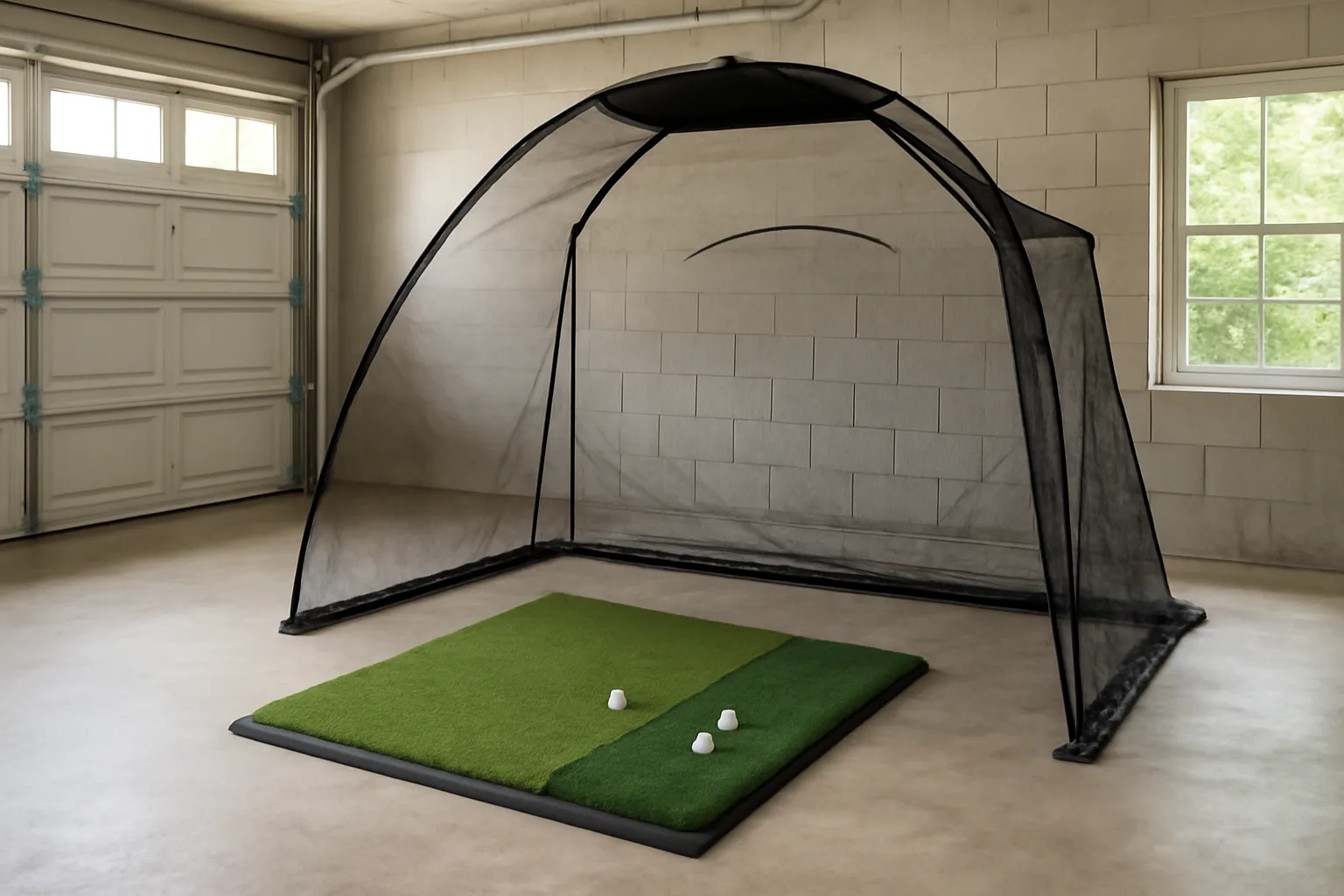
Cages and simulator enclosures are for permanent or semi-permanent spaces. They give the best miss protection, especially with side netting and an impact screen, but they need ceiling height, floor depth and a proper mat. A 3.3m wide enclosure can cost £999 before you add a hitting mat, screen projector, or launch monitor.
If that sounds tempting, read our golf simulator guide before buying. A simulator bay is a small room project, not just a bigger practice net.
Mats, Balls and Home Safety Extras
The net is only half the setup. The hitting surface decides whether practice feels useful or like hitting off a doormat.
Hitting mats
A thin £25 mat is fine for chipping foam balls. It is not fine for repeated iron practice with real balls. The problem is shock and feedback. Bad mats bounce the club into the ball, hide fat strikes, and can leave your wrists sore after a long session.
For regular use, budget:
- £40-£70: small stance-and-strike mats for light practice.
- £80-£150: better home mats with thicker base and more realistic turf.
- £200-£400: premium hitting mats or strips for garage bays and launch-monitor setups.
If you are working on contact, a better mat beats a more expensive net. It also makes your practice transfer better when you go back to the course. Pair this with the warm-up routine in how to warm up before a round of golf and you will get more from short sessions.
Practice balls
Foam balls cost about £8-£15 for a pack and are worth having even if your net handles real balls. They let you rehearse movement indoors, practise half swings, and test a new setup before trusting it with a proper ball.
Real balls are better for strike feedback, sound and launch-monitor readings. Use them only when the net, side protection and lower edge are secure. Start with wedges, then short irons, then driver. Do not make your first shot into a new net a full-speed driver because you saw someone do it on YouTube.
Side barriers and floor protection
Side netting costs roughly £60-£200 depending on brand and size. It feels optional until the first shank. Indoors, I would treat side barriers as mandatory if you are hitting real balls. Outdoors, they depend on garden width and what sits beside the net.
Put something behind the lower edge too. Balls can creep under loose netting, especially when the floor is uneven. In a garage, a rubber gym mat or spare carpet offcut can stop balls skidding into walls and tools.
Practice Drills That Make a Net Worth Owning
A net is not a magic shortcut. It is useful because it removes friction: five minutes outside becomes possible, and winter evenings are no longer written off.
Strike ladder
Put foot spray or impact tape on the clubface and hit ten half-speed 7-irons. The goal is not distance. The goal is centre contact. Then hit ten at three-quarter speed, then ten full. Stop when contact gets worse. That is better practice than bashing 80 balls while tired.
This pairs well with the range-to-course discipline in how to break 90. The net gives repetition; the drill gives the repetition a point.
Start-line gate
Place two foam balls or tees about 30cm in front of your hitting spot, just wider than the ball. Hit short irons through the gate. You will not see full ball flight, but you will see whether the start line is wildly left or right.
For putting and short-game days, switch to the advice in how to putt rather than trying to make every home practice session a full-swing session.
Wedge distance feels
Use foam balls or real balls into a safe net and make three backswing lengths: waist high, rib high, shoulder high. Use the same tempo. You are building feels, not measuring exact carry. The next time you are on a range or course, attach numbers to those swings.
This is where nets beat casual range sessions. You can repeat one movement quietly until it stops feeling strange.
Bottom Line
Buy the Spornia SPG-7 if you want the best golf practice net for regular UK home use. It costs enough to hurt a little, but it is the best balance of setup speed, containment and value. Among the best golf practice nets UK buyers can realistically store at home, it is the one I would trust for regular iron and driver sessions.
Buy the Decathlon Inesis net if you are starting out, short on space, or unsure how often you will practise. At £59.99, it is the right cheap test before committing to a bigger setup.
Buy The Net Return Pro only if you are building a serious garage bay or simulator setup. It is excellent kit, but overkill for occasional garden swings.
The mistake is spending the entire budget on the net and ignoring the mat, side protection and safe space. A £300 net with a £120 mat will help your golf more than a £600 net with a flimsy strip of turf.
Frequently Asked Questions
Can you use real golf balls with a home practice net? Yes, if the net is rated for real balls and your space is safe. Secure the lower edge, use side protection where needed, and start with slower swings before hitting driver.
How much should I spend on a golf practice net? Occasional users can start around £60-£100. Regular home practice is better served by a £250-£400 net. Premium garage or simulator setups usually start around £800 before mats and side barriers.
Are cheap golf nets worth buying? Cheap nets are worth buying for beginners, wedge practice and testing whether you will use a home setup. They are poor value if you expect daily driver practice, long outdoor life, or strong side protection.
Do I need a hitting mat with a golf net? Yes. Hitting directly from lawn damages the grass and gives inconsistent lies. A decent mat also protects your wrists and makes strike practice more repeatable.
Can I leave a golf practice net outside? You can, but it shortens the net’s life. UV, rain and wind weaken fabric and frame tension. Pack it away dry where possible, especially with pop-up nets.
What size golf net do I need for driver practice? Look for at least 2.1m width and 2.1m height, with side netting if the space is tight. Bigger is safer, especially indoors or near fences, windows or parked cars.